

Before I continue any further concerning entertainment topics like anime, films, or video games, I want to first address the elephant in the room about Christians enjoying entertainment. This is somewhat of a contentious discussion in the Christian community and, as a result, I want to develop the biblical framework— a Christian guide you’d might say— for enjoying entertainment. This is important for understanding how Christians should interact with entertainment as a whole and to prayerfully discern how to enjoy life using the Scriptures as our framework. Before I do though I want to address the opposers of entertainment.

Jokes aside, I want to address the real concerns that Christians have with entertainment and acknowledge the valid critiques against it. There are some Christians that are heavily against electronic forms of entertainment such as TV/movies, video games, anime, etc. so much so, that many of them have gotten rid of TV sets altogether. The reasons for this typically fall into 3 categories.
- Society (Satan) influences people to sin through entertainment
- Entertainment is being used to brainwash/disciple people, especially children
- Entertainment is a huge waste of time and can be spent more productively
Many people might name this differently, but essentially, all of the concerns typically fall under these three categories. Let’s consider each one.
Society (Satan) influences people to sin through entertainment. Christians who oppose entertainment have a valid point here. With the advancement of technology, humanity has gotten access to a lot more sin namely lust. It’s a pretty well known fact that pornography has run rampant throughout America and even in the church. One look at the TV or social media and you’ll quickly see the constant temptations present behind the screen. Not to mention that society loves to use the media to preach their false gospel of ‘self’ which pushes for LGBTQ propaganda and abortion. As a result, in order to put safeguards in place, many Christians have gotten rid of their TV and video games while some churches even require that their members do not watch entertainment.

Response: First, I want to be clear, if that is you, I hear you and if you believe that that is what is best for you and your family, I 100% support it. I always say, in this article and many others, that we must submit ourselves to the Holy Spirit and His Scriptures as we use wisdom and discernment when we interact with all forms of entertainment. Whether that is sticking to watching certain shows or playing certain games, or just not doing any entertainment at all, I always push for Scripture-based discernment first and foremost.
However, I want us to avoid the common mistake of attacking the mediums rather than the means of sin. What I mean is that we believe that with the rise of technology that human beings have become more sinful but that isn’t the case. It would be way too long to quote it all here, but take a quick read of Leviticus 18. God had to describe a multitude of sexual sins for the Israelites to not do such as adultery, homosexuality, incest, and even beastiality, not because they weren’t doing them and God was being careful, but because they were doing them and God had to tell them to stop! Leviticus 18:1-5 (CSB) says, “The Lord spoke to Moses: ‘Speak to the Israelites and tell them: I am the Lord your God. Do not follow the practices of the land of Egypt, where you used to live, or follow the practices of the land of Canaan, where I am bringing you. You must not follow their customs. You are to practice my ordinances and you are to keep my statutes by following them; I am the Lord your God. Keep my statutes and ordinances; a person will live if he does them. I am the Lord.’”
Romans 1:29-32 reminds us, “They are gossips, slanderers, God-haters, arrogant, proud, boastful, inventors of evil, disobedient to parents, senseless, untrustworthy, unloving, and unmerciful. Although they know God’s just sentence—that those who practice such things deserve to die—they not only do them, but even applaud others who practice them.” My point is that the medium may have changed but the sinful heart of humanity hasn’t. Since the beginning of time, human beings have been ‘inventors of evil’ and don’t need to be taught how to sin. If you think that people are more sinful because they have technology, then I think you’re giving our ancestors WAY too much credit because we see, from the beginning of the Bible, that human beings are horrendously sinful.
Does society use technology to enforce sin? Absolutely! But I just want you to have a biblical view of sin and not think that the problem is because the sin is coming through a screen. Do you know what the number one genre for books is? Romance, and not the innocent Cinderella type either, more like the 50 Shades of Gray type. The difference between a screen and a book can never change a lustful, angry, sinful and evil heart. Only the Gospel of Jesus Christ is able to turn dead men alive again and unless the Gospel is the true source of our repentance, righteousness, and sanctification, we will never be any less sinful because we don’t watch TV or play video games.
Entertainment is being used to brainwash/disciple people, especially children. Again, I 100% understand this statement! It is unfortunately true that many Christian parents, due to ease and comfort, have resorted to the TV, tablets, video games, and phones to be the primary disciple-makers of their children. Then when they get older, they wonder why their children fall so quickly into the world because they’ve been brainwashed by it. Multiple researchers such as Barna Research and Lifeway Research estimate that about 65% to 75% of children that grew up in church have left Christianity by the time they’re an adult. In some cases, I’ve even heard higher! Unfortunately, with the invention of smartphones and social media, children now have access to all types of ideologies, heresies, religions, and so-called experts who teach them about the way of life through sinful means. This doesn’t include the amount of insane things that are placed inside of TV, films, video games, and anime. Especially with games like Grand Theft Auto or kids watching incredibly inappropriate shows such as Game of Thrones (yes, I’ve really heard of this), it’s no wonder that parents are on guard against the screen.
Not to mention the very real addiction side of the problem. Kids are so impressionable that they can easily become addicted to screens which can have long term effects in the future such as lack of exercise, intimacy, focus, etc when they get older. There are so many issues concerning brainwashing and sinful discipling that occur when a person, especially a child, has long term exposure to entertainment.

Response: As a parent myself, this is also a real concern of mine and I can understand why, for the sake of children, that parents are willing to get rid of all screens in the house altogether. However, once again, I don’t think it’s the medium that is bad but the means, in this case, content. In fact, there are 3 things that come into play with children and entertainment/screen interactions: character, content, and context. ‘Character’ might seem odd but let me explain. Proverbs 22:6 (ESV) says, “Train up a child in the way he should go; even when he is old he will not depart from it.” People oftentimes limit this to spiritual disciplines but the verse doesn’t limit this because this verse is talking about training up a child in all things, and this can include entertainment and screen interaction.
Let’s be honest, unless we choose to live out in the wilderness and never have contact with civilization, it’s almost guaranteed that our children will be in contact with screens. (You’re looking at a screen reading this article!) Eventually, our children will interact with phones, TV’s, video games, etc, and it’s wise to train up a child in how they can interact with these things while keeping their Christian character strong and intact.
Personally, I grew up in both households (by the same parents), where the first half of my life was very minimal screen interaction (we did have a Sega Genesis) and the second half of my childhood was a ton of screen time as a young believer. My Christian parents were wise in developing godly character in me with my interaction with screens, primarily video games. To put this in perspective during those years, I was a devout Christian (still am by the grace of God), regularly studied my Bible, prayed, played basketball and football, played outside with my friends, played keyboard every week at church, worked part time at the school store, and I graduated high school with a 4.3 GPA— all while being a very heavy gamer on Xbox and anime nerd. Now don’t get me wrong, I’m not trying to say this to brag because I was just as much of a messed up teen with my own struggles with sinful lusts, emotions, and actions, and I was BY NO MEANS a ‘perfect kid’, but I just want to put this in perspective for some Christian parents who think that playing video games, watching anime, or TV is automatically destructive. In fact, it was because my parents trained me up to have godly character as a child, that I’m able to carry a greater quality of devotion to the Lord, focus on family and ministry, while still being a gamer.
My point with ‘character’ is that whether you decide to give your child a tablet at young age, wait until their teens, or just not give them any screens until their 18, it’s imperative that, as Christian parents, we teach them how to maintain their godly character, priorities, and responsibilities, when they eventually interact with entertainment or any screen.
This leads to the second part about content. Yes, I was (still am) a gamer and I liked to watch anime growing up, but my parents were sure to check the contents of what I was watching. Now, before I continue, I’ve stated in other articles how Paul quoted the pagan philosophers Aratus, Menander, and Epimendes in Acts 17:28, 1 Corinthians 15:33, and Titus 1:12 respectively, not because he was supporting their views but because all truth belongs to God and that we can learn genuine Biblical truths even from pagan sources. This doesn’t mean that my parents let me watch anything and everything in hopes that I would learn something biblical but my content was curated to help build godly character.
For example, I watched Christian-based films such as The Lord of The Rings, Chronicles of Narnia, and even VeggieTales, and the anime’s/cartoons that I watched (unfortunately, I am a big Spongebob fan so that doesn’t count) were shows that expressed godly virtue. A prime example of this is Avatar: The Last Airbender. If you’ve never watched this show, it is WAY more than just a little kids show. It has a 9.3/10 on IMDB making it the 7th highest rated show of ALL TIME and it has powerful themes, lessons, and character development throughout the series asking profound life questions like, ‘what does it mean to be a leader’, ‘can I be forgiven’, ‘can I be redeemed’, ‘how do I endure suffering’, ‘how do I deal with conflict especially with those I love’, ‘how do I learn from people different than me’, (from a woman’s perspective) ‘if I’m not the standard of beauty, can I still be a feminine woman’, ‘if I don’t have the same power as other people, can I still be a strong man and my family’s protector,’ ‘how do I learn the virtues of justice, humility, wisdom, self-control, or even faith, hope, and love?’ Or my two personal favorites: ‘what does it mean to be a good man’ and ‘am I willing to make the ultimate sacrifice for the greater good?’ These are not surface level questions, and trust me, this show does not give you surface level answers. In fact, you would be hard pressed to watch this show and NOT see biblical themes all throughout the show. The craziest part about it is that this is a KID’S SHOW and it does a superb job at tackling these issues.
Don’t get me wrong, even as a child, I did live as a Christ follower as any believing child would do; however, being able to see and experience godly virtues through the lens of Avatar: The Last Airbender was incredibly beneficial, not just to my life but to many other lives because it was a character-building show. There’s a reason why people love other films like Pursuit of Happiness, Matrix, Finding Nemo, Up, Lion King, Prince of Egypt, Forrest Gump, Shawshank Redemption, Spirited Away, Saving Private Ryan, and many more because these films speak so deeply to the human condition that we can connect to them and even grow in our Christian perspective on life because of the quality of virtuous content in these films.

Lastly, context is something that can be very impactful for kids interacting with screens. From personal experience, most of my friends and mentors from church lived in different neighborhoods across the city, and my first ‘discipleship group’ was actually through playing Call of Duty and Halo (to be fair, my family is military and I grew up in a military town so I’m used to being in that environment. I mean I even had a neighbor who was a Navy Seal lol). During these times, my friends and mentors would, yes, play together, but also we would be praying together, talking through Scripture, expressing our struggles, and asking questions that we had about Christianity all while we were getting headshots on a video game. I’ve even developed discipleship relationships as an adult using this same medium of video games. Furthermore, it’s much different if a kid is just watching a show by themselves versus that same kid watching a show with their parents and being taught valuable lessons through it. I remember watching movies and TV shows within the context of my family and they would teach me valuable lessons (character) through the content we were watching.
Again, I am NOT saying that you have to put screens in front of your kids. However, I am saying that, being a product of that environment and knowing other people personally that have been raised through that environment, when it’s done right with Christian character, content, and context in view, this can be a very useful tool and weapon against the influence of this sinful society.
Entertainment is a huge waste of time and can be spent more productively. Again, this is a valid point. It’s incredibly easy for people (famously men) to come home from work and sit in front of a TV lifelessly for 6 hours and then go to bed while ignoring their priestly duties as a husband and father. Furthermore, it’s common for young people to have their priorities all mixed up as they are spending hours upon hours on video games, Netflix, or Hulu as they are distracting and wasting their lives away. It’s sad that even Christians are willing to spend 5 hours a day watching Netflix or playing Fortnite, yet they can’t even spend 5 minutes reading the Bible or praying to the Lord.

Response: This is a valid concern as both a Christian and a pastor myself, I wholeheartedly agree. However, I want to also express what the Bible says multiple times in places like Ecclesiastes 8:15 (CSB), “So I commended enjoyment because there is nothing better for a person under the sun than to eat, drink, and enjoy himself, for this will accompany him in his labor during the days of his life that God gives him under the sun.” In other places where similar statements are repeated, the verses say ‘it is a gift from God.’ Yes, we should be fervent in prayer, reading our Bibles, fasting, evangelism, holiness, disciple-making, ministry, marriage, parenting, work/career, etc. On the flip side, that doesn’t mean that we aren’t allowed to enjoy life in the Lord. We are allowed to have fun, relax, laugh, and enjoy ourselves as long as it is in a glorifying way to the Lord and in our walk with Him. If someone has a deep, intimate walk with the Lord, is active in his marriage, family, church, and community, and decides after a long day of hard work and time spent with the family, at an appropriate time, they choose to relax by playing a video game— biblically, I don’t see anything wrong with that. Their priorities are in order, and if he’s playing video games or watching a TV show/movie to relax and recharge and not to escape life’s responsibilities, then I wouldn’t say it’s a waste of time but it’s a proper use of time. There is a time and place for everything under the sun, including entertainment and the difference between it being a waste and being useful is how it’s utilized properly.
Three Warnings for people on both sides of the discussion.
- Avoid Legalism
This is mainly for Christians who oppose general technology mediums for entertainment. Don’t fall into legalism that avoiding entertainment or not watching TV somehow makes you more holy. This is an unfortunate trap for many churches. Pastors and leaders believe that if they can force their members to not drink alcohol, watch TV/movies, or play video games, that somehow, the removal of these things will make them more holy. Philippians 2:12-13 (CSB) says, “Therefore, my dear friends, just as you have always obeyed, so now, not only in my presence but even more in my absence, work out your own salvation with fear and trembling. For it is God who is working in you both to will and to work according to his good purpose.”
This verse shows us 3 things: we must work hard during the sanctification process to live holy, we must work out our own salvation, and it is God who is working in us. This means that ultimately God is the one that is making us holy in the first place. Also, there is an emphasis on us working out our own salvation. Now Paul obviously isn’t saying that the Christian walk is a ‘Jesus and me’ journey because that would be a blatant contradiction of Scripture; we do need the Christian community found in the church. However, what Paul is saying is that there is a very personal aspect to the sanctifying work of salvation. People struggle with different sins and have different proclivities to sin. Some Christians may not have a problem with sexual lust but they struggle heavily with alcoholism, or others struggle with pride and anger. My point is that we shouldn’t fall into legalism in the area of entertainment because we believe that if we (or our children) don’t engage in entertainment, we are somehow more holy or our children are ‘closer to being saved.’ At the end of the day, the source of our holiness comes from God Himself, and just because something may work for one person/family doesn’t mean it works for all families. Just like the personal examples I used earlier about video games and films, I am not suggesting that everyone should be doing that as a family, nor do I expect most people to do so. My goal for bringing up those examples was to show that some people/families have positive experiences with entertainment mediums such as TV/movies, anime, and video games and that we shouldn’t be so legalistic and closed minded when discussing the topic.
- Avoid Antinomianism
On the flip side, this does not mean that Christians should be antinomian (anti-law) so much so, that we have no self-control or guardrails for holiness. Some people take Christian liberty past its limits and do things that are downright foolish. Sure you can watch TV, but should you really be watching Game of Thrones (especially, without VidAngel?) Yeah, you can watch anime, but should you really be watching anime that is littered full of sexual fanservice? Can your kids play video games sometimes? Sure, but should a 12 year old really be playing Grand Theft Auto or should you be playing the game for 6 hours a day? Is enjoying life a gift from God? Of course! But that is not God’s primary goal nor will for us in this life. 1 Peter 1:16 doesn’t say, ‘Be happy, for God is happy.’ It says ‘Be holy, for God is holy.’ Happiness (enjoying life) can be a product of holiness but it’s not the main thing. Therefore, we should be wise and holy with our choices of entertainment and make sure that we’re doing it in such a way that honors God in your heart and before other people.
- Avoid Pride
At its core, ultimately we need to avoid pride. We don’t need to be pridefully legalistic in which we believe that we are better parents, more holy, or earn extra grace points with God because we don’t have a screen in our house. On the flip side, we don’t need to be pridefully antinomian to the point that we believe we can watch or play anything and everything that comes across our screens without being negatively affected by it. Satan is a real adversary who is willing to use every method and means possible to cause us to fall and stumble; therefore, with this in mind, we have to practice wisdom, holiness, and self-control with entertainment and not be consumed by it but to enjoy it properly.
Now that we’ve explained some of the concerns and proper guardrails concerning entertainment (rather exhaustively, I might add), let’s discuss some simple guidelines for Christians who do decide to interact with any form of entertainment. In fact, I already named them: character, content, and context. I’ll go over these briefly.

Character. Your holiness and walk with God must be both first and central to your life. What I mean is that all forms of entertainment, including the things we’ll be talking about in Fun Friday articles, must be both secondary and supplementary to your walk with Jesus Christ. This will fuel everything from what you watch/do, when you do it, and even how long you do it. Your godly character will fuel your content and your context for entertainment. For example, I do love anime but because of my belief in Christ and His work of holiness in me, I am careful about the type of anime I watch so that I don’t set myself up to fall in temptation. I also make sure to watch it in the context with my wife as a date night so that it’s both enjoyable and beneficial for us in that we are spending quality time together and I’m not just aimlessly wasting time. I can’t express this enough but your walk with the Lord must come first. When your spouse, family, friends, or church community think of you, would they primarily think of you as a devout Christ follower or a heavy gamer?
Content. Use biblical wisdom and discernment that you developed from your character-building walk with God to determine what you watch and play. Some of you might be fine with playing certain games or watching certain shows while others are not. The basis for either group of people shouldn’t be ‘keeping up with the Jones’ but about staying in line with the Lord. Ask yourself questions like, ‘is this film God-honoring,’ ‘does this game have godly themes in it’ (Judges was a brutal book in the Bible but it still had Christian themes in it; it is still Scripture after all!) I’m not saying that you can’t watch or play anything with violence in it because even the Bible is very violent, but with character (holiness) in view, we should be very wise with the content that entertains us.
Context. You can be a godly man who loves the Lord, playing a perfectly fine video game, but do it at the wrong time, like on a date night with your spouse. There’s nothing wrong with watching a good show but should you be doing that while it’s time to play with your kids? Or this can even mean the context of your individual situation. For example, I sometimes play video games on date night only because my wife is also a big gamer and we’ll play together. Or maybe you’re watching an uplifting movie with your kids and explaining Gospel truths from the film. My point is that the context in which you entertain yourself is all the difference in your activities being wasteful and harmful or encouraging and restful. Though this one is last, it’s still very important, so make sure that if you are going to participate in entertainment, ‘read the room!’
I hope that this encourages you!


There are a lot, I mean A LOT of different Bible translations to choose from. Now, I address why there are so many Bible translations in a previous article but I want to talk about which translation you should read. However, it can be overwhelming trying to determine what’s the best version to read. Should you read the ESV or the LOL Cat Bible? (I’m not even joking. It’s unfortunately real lol). The last thing a Christian wants is to read a version of the Bible that is inaccurate or intentionally heretical. The goal is to find a good and widely accepted translation, that is faithful to original Scripture, understandable, and enjoyable to read while cross referencing other translations on Scriptures you can’t understand.
- Faithful to Scripture
As stated before, the Bible was originally written in three languages (Hebrew, Aramaic, and Greek) and they are all translated into one single language. When Christians say that we believe that the Bible is inerrant, which means without error, we are referring to the manuscripts in the original languages. Since 99% of people can’t read the original languages, theologians and linguists have created translations to be as faithful to the original Scripture as possible for us.

Now some translations try to be as literal as possible to the original in terms of sentences and word structure whereas some translations focus more on readability (it’s no use to have a literal translation if you can’t read and understand it). However, there are some translations that are either unfaithful to Scripture, poorly translated, or paraphrased.
An example of an unfaithful translation is the New World Translation of the Holy Scriptures (The Watchtower Bible). This is the Jehovah Witness Bible and the reason why it’s an unfaithful translation is because it changes the core beliefs of the Gospel and teaches polytheism. An example of a poorly translated Bible is the Passion Translation. The technique used to translate it is not recommended by scholars and it teaches confusing concepts about Christianity which is why it should be avoided. Not to mention that there was only one man, Brian Simmons, who has famously stated that he was given the directive to translate the Bible ‘from God’ through visions and dreams. The point is that you want to make sure that you avoid unfaithful translations that are known to twist the Bible to support heretical views and false religions.

Finally, paraphrase Bibles are great resources to have but they should be used as supplementary to other versions of the Bible that are more literal. Some examples are The Message Bible and God’s Word translation. Again, these are not inherently bad but instead of being primarily a translation(they tell you what the original language says), they act more like a close interpretation(they help tell you what the original language means). I would highly suggest treating paraphrases as faithful commentaries more than faithful translations of the Bible. Some people would say that the New Living Translation(NLT) is a ‘paraphrase’ but I have to disagree. I know of many faithful pastors who use the NLT and say that it is more of a mixture between formal equivalent (word for word) and functional/dynamic equivalent (thought for thought) translation than a paraphrase. Where things get a little bit confusing between the translation methods is that the NLT is an updated version of The Living Bible (TLB) which is a famous paraphrase version of the Bible. Nevertheless, in my honest opinion (and to my knowledge), even if you consider the NLT to still be a paraphrase, I would consider the NLT as a viable translation because its translation is quite similar to other Bible versions and is a widely accepted, well-vetted version of the Bible.
When in doubt, just ask your pastor and your leaders. In fact, this should be the FIRST person you ask before you go searching. Ask your pastor for a good list of translations that he uses or recommends. I’m not saying that he will be able to tell you the exact accuracy or variations of every version but, at the very least, he should be able to point you in the right direction in finding a faithful translation.
- Read a translation you can understand
There’s no point in reading all the thee’s and thou’s in King James if you have absolutely no idea what it means in the Scripture. It’s important to be honest with yourself and consider your reading level and style. If you have a choice between ESV or NIV but you can understand NIV way better than you can comprehend ESV, then choose ESV. Just kidding! Choose the NIV obviously. You don’t get any special kudos for using a version that you can’t understand. As long as the Gospel message is the same and the translation is faithful to Scripture, that’s all that matters.
For example, I have a scientific background and an analytical mind so I can read versions like NKJV, ESV, NASB, etc and follow along with little to no problems. I prefer these versions both for my pastoral study and for my everyday reading because I enjoy the literary nuances that come from more literal translations. My wife on the other hand is a different story. She prefers easier to read language with translations that get to the point. She’ll read versions like NIV or CSB (another one of my personal favorites). Our translation differences don’t make one of us more saved than the other, it just helps us to understand it better in our daily reading.

Side Note for Preaching/Teaching.
Now for preaching, I’ll up the ante a bit. I believe that you should use more common and well known translations that are considered ‘standards’ for that church. Furthermore, I would recommend you stick with more literal versions instead of dynamic (thought-for-thought) translations. The only two that I would personally give a pass here for dynamic translations are typically the NIV and the NLT. However, you still have a good range of translations to choose from in order to be understandable to your congregation.
Personally, my two ‘go to’ translations are the CSB and the ESV. If I’m invited to preach to an older, traditional crowd, I would typically use ESV. If I’m preaching to youth or a more contemporary crowd, I would use the CSB. The reason why I like these translations is because they are both faithful and versatile in nearly any context. Also, if you notice, almost every verse that is quoted in these articles are in these two translations.
Rule of thumb: if you’re a visiting preacher or teacher, ask the leadership team what translations they use. If it’s one you don’t normally teach from, ask the leadership about alternative versions that are similar. Using the example above, if they prefer KJV, ask if you can use NKJV, ESV, or ASV as good alternatives. If they’re adamant on using a specific version, make sure you study the verse in multiple versions that you’re familiar with in order to get a good understanding of the text.
- Find a translation that’s enjoyable
I think people forget that we can actually enjoy reading the Bible! Psalm 1:2 (ESV) says, “His delight is in the law of the Lord, and on his law he meditates day and night.” We should delight and enjoy reading the Scriptures.

There are essentially three great reasons to read the Bible but the third one often gets overlooked. The first is obviously to study and learn more about the doctrine/teaching of the Bible. Think of Paul’s letters in the New Testament and the Gospels which are filled with doctrinal teachings about what we should believe and do as Christians.
The second reason is for devotion and memorizing Scriptures which are often done with the Psalms and Proverbs. Paul teaches us in Ephesians 6 that the sword of the Spirit is the Word of God meaning that our greatest weapon in spiritual warfare is Scripture. We must meditate on the Scripture and have the truths of God laced into our hearts and minds, so that when the enemy attacks, we can lean on a promise of God from the Bible. This can only be done if we spend great time in devotional study and if we memorize Scriptures. Now this memorization can be something as grand as memorizing an entire book/epistle of the Bible (like John Piper), or it can be used to remember key verses. Either way, when we choose a translation, choose one that is faithful to the text and easy for you to remember. For instance, while John Piper remembers Scripture typically in the ESV, Joby Martin recites verses in the NIV. Regardless, they’re memorizing Scripture!
The last, again often overlooked, reason is to understand the overarching story of the Bible. (The official term is called biblical theology for the nerds out there). Far too often, Christians look at a verse and completely miss or are shortchanged by the context of the story. For example, 1 Samuel 30:6 (CSB, emphasis mine): “David was in an extremely difficult position because the troops talked about stoning him, for they were all very bitter over the loss of their sons and daughters. But David found strength in the Lord his God.” Now you can understand this text just by reading the verse; however, the verse grows in magnitude when you realize that this is a defining moment on his journey to the throne where, right after this, Saul dies and he becomes king. Furthermore, you know how beat down he was after he served Saul faithfully and was betrayed. Then he served his allies, the Philistines at the time, faithfully ‘like an angel’ and was rejected. After going through all of this, THEN he loses his family and his home is burned. The only way to know all of this is if you take the time to read First Samuel.
Christians forget that the Bible is a drama that is expressed over a thousand years that reaches its pinnacle at the cross. Furthermore, the Bible is purposefully written to give us real historical characters that we can glean from such as Jeremiah, David, and Abraham so that we can learn from their victories and avoid their mistakes.
My point is that you should seek to read the Bible as a whole story not just its parts and the best way to do that is to find a translation that you can enjoy reading large portions of the Bible like a normal book. Read the Bible to study, memorize, and enjoy! For example, when I study to prepare sermons, I might cross reference with translations such as the KJV/NKJV, NET, NIV, NLT, or the ISV, but I enjoy reading in CSB or ESV. They’re good balances of my analytical mind and my long reading comprehension. A good way to determine an enjoyable reading translation is through the Old Testament. Pick any book or multi-chapter story such as Genesis, Judges, Daniel, Ruth, or Esther. Once you found it, if you can read that book and understand the story, you found a good translation for you. Using myself as an example again, if I read KJV/NKJV my brain automatically goes into study mode. Personally, ESV and CSB are two translations where I can read the Bible like a story and turn on my study mode when I need to study the subtle nuances of Scripture as a pastor-teacher.
Conclusion
Ultimately, the goal is to find a translation that is faithful to original Scripture, understandable, and enjoyable to read. If you find one that checks all three for you, you’ve found the perfect translation that works for you! If you haven’t found it yet or are having trouble, that’s fine. Just make sure that the first two boxes are checked because those are the most important. I found CSB and ESV rather recently in the last 3-5 years. The first 20 years of my Christian walk, I used KJV, NKJV, and NIV as my main translations which all checked the first two boxes for me. Be patient and take your time finding the right translation. Also don’t forget to ask your pastor and read into the Bible translations yourself to see if it’s a good fit for you.
Last piece of advice: don’t jump into a brand new translation! It feels like there’s a brand new translation coming out every year and honestly, I think there’s way too many of them. A recent example of a bad translation, as stated earlier, is the Passion Translation. Thankfully, theologians are fast acting in finding discrepancies and errors in translation so they’ll call them out in order to avoid them. However, I suggest only considering translations that are at least 10 years old.
Now I’m not talking about updated versions of older translations. For example, NKJV is simply a language update without all the Thy’s and Thou’s of KJV. Other examples: CSB is an update of HCSB, NRSV is an update of RSV which is an update of the ASV translations, and so on. By new translations, I mean brand new translations that are not connected or updates of previous ones. A good rule of thumb is just make sure that it’s over 10 years old and has mostly good reviews from theologians. This ensures that the translation has some vetted years under its belt in Christianity and that theologians, the people who CAN understand the original language, have read it, and see it as faithful to the Greek, Hebrew, and Aramaic. Below I have a small list of well known translations that can get you started.
Literal (also called formal or word-for-word translations)
- KJV/NKJV*
- *I’ve expressed in other articles how the KJV has its flaws as a translation since it uses the youngest manuscripts and has well-known scribal errors. However, as long as this is understood and taken with a grain of salt, the KJV/NKJV can still be great translations to read especially since many Christians grew up on this version of the Bible. Just read with caution.
- ESV
- CSB
- NASB (1998 and 2020 editions)
- RSV
- LSB
Dynamic (also called functional or thought-for-thought translations)
- NIV
- NET
- ISV
- NLT (though some may consider this paraphrase, many theologians would agree that it’s faithful to Scripture)
- NIrV (NIV for kids)
- REB (British audience)
I hope this article has blessed you!
Leave a Reply


Those four words back in 1992, began the unfortunate era of horrendously corny Christian entertainment. Nowadays, almost every time I hear about a new Christian movie or TV show coming out, it’s an immediate eye roll. Either the film is an unrealistic storyline where Christians are seen as picture perfect people whose problems are magically solved through the power of prayer, or they are horrible ripoffs of popular IPs. For example, take The Reconciler which got a 1.9/10 on IMDB! It’s a Christian ripoff of Saw where instead of trapping people in impossible situations where they have to do unimaginable acts to escape, people are trapped in a merely inconvenient situation where the only way out is through verbal reconciliation with one another. Want to know what I thought?

The list goes on and on, so much so, that Christian films have been notoriously known among both producers and consumers for having low quality production, writing, and acting. Now, believe it or not, I actually have a lot of respect for blazerunners in Christian films such as David A.R. White (the founder of Pure Flix and the young man in the first picture), the Kendrick Brothers, and Kirk Cameron among others. They occasionally produce some solid films and I know that they’re doing their best to provide clean Christian entertainment. However, over the years, the quality just hasn’t been present. Prayerfully, with the rise of new companies such as Angel Studios, the landscape could potentially change but it’s still an uphill battle.
To the Christian film industry’s credit, at least they exist. Meanwhile, the Christian video game market is about as memorable as Ebiasaph in the Bible. Remember that guy? Exactly. To be fair, Gate Zero looks promising but other than that, there are virtually no Christian video games and the ones that do exist are essentially Bible trivias or biblical reenactments.
Books, on the other hand, are still prevalent but the market is still an uphill battle for Christian book writers. This comes from firsthand experience as I’m working on publishing a Christian sci-fi/fantasy book (prayerfully multiple books for that matter). Speaking with a very successful publishing agent who’s also a Christian, she stated that because I am a straight Christian male, it’s highly unlikely that a big publishing house will take my book. A STRAIGHT CHRISTIAN MALE?! That’s my whole existence!

Furthermore, she stated that there are absolutely NO major Christian publishing houses that are taking sci-fi or fantasy novels right now. This literally means that if J.R.R. TOLKIEN or C.S. LEWIS submitted their novels today, they would get the swiftest decline from both the mainstream and the Christian publishing houses which is an insane concept to think about! (By the way, that is no indictment on her as an agent, she was simply relaying the status of the current publishing market). Now obviously, I am not saying that my writing or other contemporary writers are writing on the level of Tolkien or Lewis, nor am I saying that there are no Christian fantasy writers (Mark Batterson, Priscilla Shirer, etc). What I am saying is that unfortunately, Christian writing has been limited to being strictly theological/historical, lifestyle hacks, or contemporary romance fictions.
This begs the question, ‘why is Christian entertainment so bad?’ Though there are a variety of reasons, here are a few answers to the question.
- Christian entertainment is designed to inform not entertain
This is probably the biggest crutch of the Christian entertainment industry as a whole. Christian movies, TV shows, books, and video games are primarily focused on informing people of the Gospel message more than entertaining people. Now I know what you’re thinking, ‘Fool, what’s wrong with informing people about the Gospel message? We’re here to share the Gospel, not to entertain!’

I am in full support of using all media outlets to share and spread the Gospel. However, notice what I’m arguing. I am not talking about Christian services, Bible studies, or commentaries… I’m talking about Christian entertainment. The whole purpose of entertainment is defined as a form of activity that holds the attention and interest of an audience or gives pleasure and delight.
Whether you like it or not, the majority of Christians work a stressful 9-5 and when they come home at the end of the day, they seek to unwind by either watching a TV show, movie, sports game, reading a book, or playing a video game. For those Christians who think it’s evil or unbiblical to enjoy life, read this verse: “So I commended enjoyment because there is nothing better for a person under the sun than to eat, drink, and enjoy himself, for this will accompany him in his labor during the days of his life that God gives him under the sun.” (Ecclesiastes 8:15 CSB) Obviously, I am not saying we do this excessively because that’s sinful. What I am saying is that entertainment, in and of itself, is not bad and it belongs in a separate category from information.
This leads back to one of the biggest crutches of Christian entertainment that they are trying to produce informationals or sermons through the media. Even the Kendrick Brothers have admitted that their movies are more like video sermons than actual films. Here’s the problem: people don’t watch films, play video games or read fiction books to be preached to, they want to have an experience. If I want to watch a sermon, I’ll watch a local pastor, R.C. Sproul, John Piper, or Voddie Baucham. Chronicles of Narnia and Lord of the Rings are both Christian titles with major Christian themes but they are entertaining because of great storytelling, writing, and compelling characters.
- Low Quality Production
This is probably the most obvious one but Christian entertainment has an infamous reputation of looking incredibly low quality. Now I know what you’re thinking, ‘Weak Fool, the quality is low because the budget is low.’ For those who may not know much about the industry, this is a very reasonable assumption. However, look at this small clip below:

This is a scene from Godzilla: Minus One. If you haven’t seen it, you should honestly watch it because it’s a beautiful movie and one of my favorite movies ever. This movie was so good that it ranked in the top 250 highest rated movies of all time on IMDB. It got a 98% critic AND audience score on Rotten Tomatoes and won the Oscar for Best Visual Effects in 2024 over nominees such as Guardians of the Galaxy 3 ($250 million budget), Mission Impossible: Dead Reckoning Part One ($291 million budget), The Creator ($80 million budget), and Napoleon ($200 million). Godzilla: Minus One accomplished all of these feats and beat all of these competitors with a budget of… are you ready? $15 million!! You read that right. $15 million budget! Angel Studio’s Sound of Freedom, which was another great movie by the way, made over $250 million dollars with the same budget!
The issue is not budget, the issue is mastery of the craft. Fixing bad writing, dialogue, and plot holes are free. Most of the production issues are not with budget, but rather with the quality of lighting, sound, cinematography, etc. Good lighting and cinematography, for example, mainly come down to technique rather than budget. The same can be applied to video games. Unreal Engine and Unity, the top two most popular and best game production engines used by major gaming companies around the globe, are completely free to use. Better production quality is simple but not easy. It takes a lot of hard work. I am not saying that budget is a complete non-factor but as we see from the two examples above with Godzilla and Sound of Freedom, hard work and mastery of the craft will almost always trump any budget.
- Fear of Creativity

By fear of creativity, I mean the fear to step out into the unknown and to actually use the creative and imaginative minds that were given to us when we were created by God in His image. It’s truly heartbreaking because up until the last 75 years, Christians used to be some of the most creative artists, musicians, scientists, authors, and architects that stretched the limits of imagination in God’s creation! The painting you see above is a painting of a Bible by one of the greatest artists of all time: Vincent van Gogh. From Gogh, Michelangelo, and Kinkade to Bunyan, Tolkien, Dickens, and Lewis to Bach, Beethoven, Mozart, and Handel to Newton, Pascal, Carver, and Boyle; these Christians embarked on a never ending journey of finding the depth of the limitless beauty, imagination, and complexity of their Creator, Jesus Christ! Don’t tell me that Christianity and the Bible are ‘too restricting’ when the greatest minds in almost every field have come from people whose very imagination was only limited by the very God they served.
Why, oh why, in an age with the most tools, resources, and opportunity, literally at our fingertips, have Christians become the most dull, dry, and dreary? Fear. Unfortunately, the Christian atmosphere has become like the famous Japanese proverb: “The nail that sticks out gets hammered down.” Let’s be real, the landscape of Christianity has been so hostile to the point that we’re so afraid of trying something new, because the moment we do, we will most likely be met with much backlash. Just look at the Christian films in 2023 such as Sound of Freedom, Nefarious, and The Chosen(aside from any theological debates on the Second Commandment) which were all met with extreme backlash from the Christian community.
I’m not saying people are perfect nor am I saying that we shouldn’t call out heretics in the entertainment industry. What I am saying is that, at least they’re trying to do something! Christianity today, especially in the West, has become a Christianity of strictly talk and criticism but no action. Last time I checked, the Bible gives us a lot of actionable commands. However, many Christian creators are so afraid of being imaginative, because they’re afraid of being criticized or having their brand damaged, that they would much rather stick to familiar redundancy than to branch into godly creativity.
As a result, as stated earlier with the major Christian publishing houses, virtually no one is looking to publish a Christian fantasy or sci-fi novel. This means that the theoretical end of Christian speculative fiction was 75 years ago in the 1950s through the works of Tolkien and Lewis. It also means that the endless, redundant cycle of bad Christian entertainment will continue. Films will continue to be strictly video sermons, reenactments, and low quality productions. Books will be restricted to theology, history, and romantic fiction at best. Finally, Christian video games will either die out completely or be reduced to nothing more than Bible trivia.
Conclusion: What’s the Solution?
I’ll discuss more thoroughly how to make good Christian entertainment in another article. Nevertheless, the solution is NOT to disregard entertainment but to reclaim biblical creativity and beauty. Christians are created in the image of God and in His likeness. The same God that masterfully created the stars, intricately designed the atoms, elegantly clothed the flowers, meticulously crafted the gorgeous landscapes of mountains, forests, and oceans, created us in His image with the mind of Christ for both righteousness and imagination.
Exodus 35:35 (CSB): “He(God) has filled them with skill to do all the work of a gem cutter; a designer; an embroiderer in blue, purple, and scarlet yarn and fine linen; and a weaver. They can do every kind of craft and design artistic designs.” God gave them the skill to create the tabernacle. Now I know some people may believe that God stopped giving people these gifts but He hasn’t! The same God gave Van Gogh the skills to paint, Bach the ear to compose, Newton the mind to calculate, and Lewis the heart to write. The creativity to make movies and film, to write books and poetry, to design games and new worlds, to compose musical scores, and so much more is a gift from God: the One Who is not only the most creative Being but the One Who made creativity in the first place.
Go create!
Leave a Reply
Bible translations… Why are there so many and how do I know which ones are good?

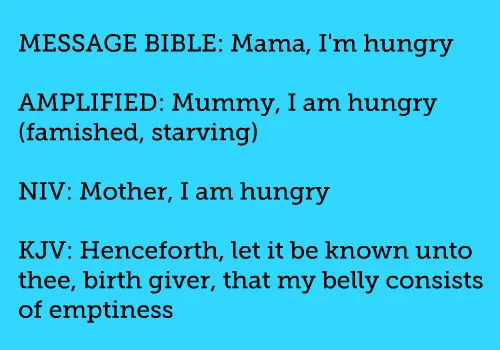
Look, I sometimes even ask this question. I can’t tell you how many times I’m on Bible Gateway or some other Bible app and I scroll through the countless translations of the Bible asking the same question:

Before we can answer the question why there are so many translations, we have to ask the question, ‘what is a translation?’ The basic understanding (meaning this is simply Google’s definition which, in this case, is sufficient) is that to express the sense of words or text into another language. For example, ‘hello’ in English can be translated as ‘hola’ in Spanish or ‘konichiwa’ in Japanese but they mean the same thing. So in the broadest sense, a translation is converting the original biblical languages into another language such as English, Spanish, French, etc. Now on the surface, this seems rather simple; therefore, why are there so many translations? (Though there is a slight difference between a Bible translation and a Bible version, for the sake of simplifying the article and the discussion, I’ll be using these terms interchangeably) Here are four reasons why there are so many Bible translations.
- Language is incredibly complicated
Consider reading this article. In order to understand this article, you have to know things such as grammar, syntax, vocabulary, semantic range (range of word usage), punctuations, sentence structure, conjunctions, etc. All of these things and more are needed to understand the English language. Now imagine this: every language has its own set of rules for each category within communication. For example, the biblical Greek language is so complicated that there are not always one to one translations for the meanings of words. In the Greek language, a verb, for instance, has not one, not two… but SEVEN characteristics that must be considered for translation: person, number, voice, tense, aspect, time, and mood. Furthermore, each one of the seven characteristics has multiple subcategories in order to determine the meaning of a single verb!
Not only that but the sentence structure is completely different. If you read Ephesians 1:3-14 in English translations, it’s almost always structured as multiple sentences. If it wasn’t, it would be considered a run-on sentence and your English teacher would fail you. However, in the original Greek language, Ephesians 1:3-14 is one sentence and it’s not considered grammatically incorrect in the Greek language. One sentence!
Another major aspect that people forget in Bible translations is that the Bible was written in not one, but three different languages: Hebrew, Greek, and Aramaic. When you pick up a translation such as CSB, NIV, NASB, ESV, or whatever language you use, you’re picking up an English version of the Bible that is translating three different languages into one and each language has its own rules, laws, and interpretations for their words. This is why you can have multiple reliable versions translate a verse slightly differently. Let’s consider five popular translations of Philippians 2:6.
KJV: Who, being in the form of God, thought it not robbery to be equal with God:
NIV: Who, being in very nature God, did not consider equality with God something to be used to his own advantage;
CSB: Who, existing in the form of God, did not consider equality with God as something to be exploited.
ESV: Who, though He was in the form of God, did not count equality with God a thing to be grasped.
NLT: Though He was God, He did not think of equality with God as something to cling to.

Before we go further, let me be clear, all of these versions are essentially saying the same thing. However, they are each attempting to translate as closely as possible the meaning of the Greek words that Paul is using to explain Christ.
Let’s look at the first part of Philippians 2:6. Some versions such as KJV, CSB, and ESV say that Jesus existed in the form of God. NIV says that Jesus had the very nature of God, whereas NLT says that Jesus was(is) God. This tension is coming from the two words hyparchon and morphe in the Greek language. The first word means ‘to exist’ or ‘to be’ whereas the second word, which appears only three times in the New Testament, can mean ‘form’ or ‘nature’. If we take the second half of the verse, a major component for translation is the word harpagmos which can mean ‘to rob’, ‘something to be grasped’ or ‘to seize’ and this word is only used once in the entire New Testament. (For those looking for the original languages, I highly suggest getting apps such as Logos Bible Software, Olive Tree, or Blue Letter Bible. Preferably, I use Logos Bible Software and it’s where I get my Greek words and definitions)
Just by looking at these three Greek words, we’re already diving into some serious complexity when trying to translate this verse. The reason why I’m also telling you the number of times the word is used is because it shows that there are not a lot of cross references in other places where translators can try to interpret this Scripture. Not that they’re translating this wrong but you have to understand, there are only 10 words in the Greek for this single verse but all of these meanings have to be considered for each word in order to get the most cohesive outcome. Therefore, considering the utter complexities of translation as a whole, Thornhill states, “no translation can be totally literal (exact) all the time.” The only way that you are able to get the totally literal (exact) translation all the time is to be an expert linguist in Greek, Hebrew, and Aramaic.
- There are different ways to translate
As stated earlier, translation is a complex field because languages are complex. Therefore, there are typically three approaches to translations: formal equivalence (word-for-word), functional equivalence (thought-for-thought), and paraphrase. (By the way, this is typically where people differentiate between ‘versions’ and ‘translations’. Versions are typically the way or method of translation whereas translation deals with converting one word to another. Just food for thought!) Let’s consider each one.
A formal equivalence translation means that the translators are trying to recreate the text in its original grammatical structure as closely as possible. This is typically where we get the term ‘word-for-word’ translations. A few popular examples are KJV/NKJV(we’ll talk about this one later), ESV, CSB, and NASB. These are great translations but the difficulty with these translations is that they have complex grammatical structures, rigid syntax, and thicker theological language (think of words like propitiation or atonement). Furthermore, the reading level is much higher. For example, NASB is written at an 11th grade reading level while ESV is written at a 10th grade reading level. The average reading level in America is 7th grade meaning that this can be tougher to understand for the average person.
Let’s address the KJV Problem.

Just to be clear, I do love the KJV/NKJV Bibles! I grew up reading, understanding, and memorizing both KJV/NKJV translations and I still quote many verses in these translations. Hey, the name of our church comes from Acts 9:20 in the KJV! However, there’s been this big trend going on that KJV is the only accurate translation because it’s the oldest, and the new translations are trying to twist Scripture. Though this has been dressed in many different ways and other places, I just want to clarify it here in case you’re unaware of the situation.
- The KJV is the oldest English translation but it uses the youngest manuscripts.
The KJV was famously published in 1611 by King James (who would’ve thought right?) However, the manuscripts, which are the literary pieces with their own original languages used as the foundation to translate the King James Version, were well-known to have dated back to 1100 AD: over 1000 years after the events of the Bible. Meanwhile, newer translations such as the ESV, RSV, CSB, NLT, NIV, and many more have access to manuscripts that date back to the first three centuries thanks to the Dead Sea Scrolls. Therefore, though KJV is the oldest translation, it does not use the oldest manuscripts which are more accurate.
- The KJV translators only had access to about 10-15 manuscripts.
Of those manuscripts that date back to around 1100, Erasmus, one of the lead translators at that time, only had access to 10-15 manuscripts (depending on the historical source). Meanwhile, our current translations have access to thousands that are, again, older than the ones the KJV used.
- The KJV has well-known scribal (not Scriptural!) errors.
If you notice, when you read the Lord’s Prayer, 1 John 5:8 or Mark 16:9-20, in translations like the ESV, CSB, NLT, and others, there is either something omitted, changed, or notated for these sections. In the Lord’s Prayer, the last doxology, ‘for thine is the kingdom, the power, and the glory forever,’ is omitted from other translations because we now know that this was a scribal error because this was added to the text. Many scholars believe that this was added because it was a common way to end prayers in the local church. 1 John 5:8 in the KJV says that there are 3 witnesses in heaven: the Father, Son, and Spirit. The older manuscripts say the Spirit, blood and water. Nearly all of the oldest manuscripts exclude Mark 16:9-20, hence why nearly every other translation beside the KJV makes a note of this.
- KJV, when properly weighted, is still reliable and respected.
Looking at these errors, you might be ready to throw away the KJV/NKJV altogether but I wouldn’t write it off so hastily. Despite the age and number of manuscript sources and the scribal errors, the KJV/NKJV is still a good and respected translation within the Christian community. In fact, many theologians agree that, despite the many discrepancies, Christians will not lose any of the major tenets of the faith reading the KJV/NKJV. Think about it, most of the great preachers and legendary theologians in history used this translation such as Charles Spurgeon and Jonathan Edwards. However, the problem is not in the translation itself but in the community behind the translation. The division in the Christian community is when people believe that KJV is the best translation simply because it’s the oldest, and when these same people conflate the translation with the manuscripts. This is well-meaning in that these Christians are afraid of people trying to change the meaning of the Bible and to that, I agree and applaud with them. The issue comes in when they are so authoritative about it that they believe that the KJV is the only Bible and that, if you don’t use the KJV, you’re either using a flawed translation, or you might not even be a Christian at all.
The irony of it is that, with a little bit of thought, we can see how foolish this stance really is. Not everyone in the world speaks English! Imagine taking that same logic to the oldest Christians in Ethiopia or Armenia, and saying that they’re using the wrong Bible translation because it’s not in the English KJV? Mind you these countries were Christians 1300 years before the KJV was even translated! The ancient Jews didn’t speak English! Moses wrote the Pentateuch in Hebrew, part of Daniel is written in Aramaic, the New Testament was written in Greek, and many of the Christians in that time spoke in Aramaic or Latin. The problem is that if we use the logic of the KJV, it means that Christians either (1) can only speak/read English which is a contradiction of Revelations 7:9, (2) only had access to the ‘real Bible’ for 400 years, (3) never understood the Scriptures for the first 1600 years of Christianity, which would be a HUGE problem for the history and validity of Christianity as a whole, or (4) people were never Christians until 1611 because they didn’t have access to the King James Version of the Bible. You get the idea.
Again, I’m not saying that you can’t read the KJV/NKJV, but it’s imperative that you read it with a grain of salt. The beauty of the translation is that you can still have biblical sound doctrine just like reading the new versions. Nevertheless, a good rule of thumb is that if you see a discrepancy between the KJV and a newer (reliable) translation such as the ESV, CSB, or NASB, choose the newer translation of that verse since you know it’ll be more accurate.

Functional equivalence, also known as thought-for-thought, worries less about the grammatical structure of the original language but makes sure to translate the intended idea of the text. Think of popular translations such as NIV, NLT, NET, NRSV. These translations are written at the average reading level of 7th grade and are typically designed for regular, everyday reading. Some theologians would consider the NLT (New Living Translation) to be a paraphrase translation, but in reality, the NLT uses a combination of functional equivalence and paraphrase and it leans more on functional equivalence. Furthermore, there are a lot of biblical pastors and leaders who use this translation regularly as a faithful version of the Bible.
Finally, paraphrase versions are concerned with translating the text in a more modern or culturally contextualized form of the English language. There are some joke versions of this such as the LOL Cat Bible and the Gen Z Bible but on a more serious note, some popular paraphrase translations are the CEV, MSG, and TLB. On this note, I highly recommend that you stay away from paraphrase translations as reliable sources to learn the Scriptures and treat them more as commentaries. The reason why you should keep paraphrases as commentaries and not as Scripture, is because paraphrases are heavily interpreted versions of the Bible. To put it another way, paraphrase translations are more like sermons than Scriptures. Obviously we can have faithful sermons but the issue is that you can have a virtually infinite amount of sermons (communications) based on the same verse (content). An example is the Message Bible which is an interpretation of Scripture through the lens of Eugene Peterson which is like hearing the Bible preached by him essentially. I love listening to sermons from John Piper, Tim Keller, and Voddie Bauchum but all of them would agree that their sermons are not the same as Scripture itself. This is why you should use them like a sermon or commentary. Using them as a commentary means that you should treat paraphrases as supplementary/supportive material to your substantive Bible reading and study. Nevertheless, this leads to my third point.
- Different Reading Styles and Levels
Now I’ve heard some people say, ‘the Spirit will help you understand the Scriptures.’ Please don’t fall for this trap!

This typically comes from 1 Corinthians 2:14-16 (CSB, emphasis mine), “But the person without the Spirit does not receive what comes from God’s Spirit, because it is foolishness to him; he is not able to understand it since it is evaluated spiritually. The spiritual person, however, can evaluate everything, and yet he himself cannot be evaluated by anyone. For who has known the Lord’s mind, that he may instruct Him? But we have the mind of Christ.”
Yes, we do need the Holy Spirit to truly understand the Scriptures; however, too many people use this as an excuse for translations when the Bible is talking about understanding the Gospel message. If we take this Scripture literally that we have the ‘mind of Christ’ that means that every Christian would be omniscient. Obviously that’s not true. In fact, in the same chapter we know Paul is talking about having the wisdom and knowledge of the Gospel because he said, “When I came to you, brothers and sisters, announcing the mystery of God to you, I did not come with brilliance of speech or wisdom. I decided to know nothing among you except Jesus Christ and Him crucified.” (v.1-2) The point is that the Spirit helps us to understand the Gospel, not every word in a translation.
To bring it back to the topic, another reason why there are many translations is because of different reading and comprehension styles. As stated earlier, some translations are designed for higher reading levels while some are designed for lower reading levels. It’s unfair to give your six year old a copy of the KJV Bible and expect him or her to understand every word written in it. Yes, even if they are saved and baptized. Even Jesus addressed people differently. In the Sermon on the Mount, He’s talking to the common man so He talks more softly and uses the phrase, ‘you have heard it said…’ However, when He talks to the Pharisees and scribes who have read the Old Testament, He talks more harshly and says, ‘you have read…’ Jesus uses different levels of language based on who He’s talking to so that people can understand Him.
Though I’m not saying that people should blindly use any translation out there, I am saying that just because someone may be reading from the NIV while you read from the KJV, it doesn’t make you a ‘smarter’ or ‘better’ Christian. It’s better for you to read the NIV and actually understand what you’re reading than to read the KJV and have no clue what the verse actually means.
- Different Purposes
What I mean by different purposes is that there are different reasons to use specific versions when reading the Bible. This is primarily pertaining to teachers and pastors of the Word but it can relate to the everyday Christian.
For example, typically for teaching the Word as a pastor or elder, it’s best to exegete (art of interpretation and hermeneutics) with translations that are word-for-word. Not saying that a pastor can’t teach from other translations but I would be concerned if my pastor only studies and reads the Message version of the Bible, for example. Why? Because paraphrase translations are pretty much commentaries that chew your food and interpret the text for you. Now, I’m not saying that a pastor must know fluent Greek, Hebrew, and Aramaic. However, a pastor, who should be able to teach sound doctrine, should be able to look at various translations and be able to exegete the text accurately.
On the other hand, for the average everyday reading, it makes more sense to read thought-for-thought versions of the Bible such as NIV or NLT. For example, for my everyday reading, I typically read CSB or ESV versions. When I preach, I typically preach from CSB but I study KJV, ESV, NET, IST, and NIV. I like to do this so that I can read the same verse from multiple perspectives in order to get the most accurate interpretation and understanding of the verse. The reason why I like to preach from CSB (or sometimes ESV) is because CSB is considered a word-for-word translation but it uses more common language when I have to preach in front of both kids and adults. The point is that there can be different uses and purposes for each translation which is why there are many.
- Confusion
Though I said only four reasons, this is a fifth bonus reason that often gets missed. Unfortunately, there are heretics and cults who are purposefully making their own versions of the Bible in order to cause confusion. Two examples are the Passion Translation and the Watchtower Bible (New World Translation of the Holy Scriptures). The Passion Translation is a paraphrase Bible that is very inaccurate and uses so much freedom in its interpretation that it veers way off course from the original text. Furthermore, Brian Simmons, the writer of the Passion Translation, says that the Lord visited him in some weird spiritual (almost psychedelic) experience that drove him to make his own translation. Similarly, this is how the Watchtower Bible came about which is famously the Jehovah Witness version of the Bible.
Essentially, both of these verses translate the Bible and make small yet major changes to the text which changes the doctrine of Christianity. For example, in the Watchtower Bible, John 1:1 says, “In the beginning was the Word, and the Word was with God, and the Word was a god.”

Did you see it? The Watchtower Bible says, ‘the Word was a god.’ In the original text, it reads, ‘the Word was God.’ This subtle difference teaches that Jesus was a demi-god (lesser god) and immediately changes Christianity from being a monotheistic religion to being a polytheistic religion. This is one small but major change among many that are in this translation of the Bible. Therefore, it’s imperative that when you choose a translation to vet your sources, ask your pastor, and use translations that are commonly accepted in the church.
Conclusion
Ultimately, there are many reasons why there are so many translations. Most are good but others are bad. The Bible is written in three different original languages (Hebrew, Greek, and Aramaic) and each of these languages has their own grammar, vocabulary, and rules. This adds so much complexity when trying to translate three languages into one, which can create different translations that are all doing their best to be accurate to the original. Furthermore, since people read at different comprehension levels and use the Bible for different purposes (though still good purposes), it can create the need for different translations. Nevertheless, Christians should still use prayer and wisdom when selecting the right translation for them.
I pray that this was beneficial for you!
Leave a Reply

Up until recently, Christians were notoriously known for making subpar (sometimes laughable) forms of entertainment. From movies, to TV shows, to video games, the Christian industry fell short, time and time again. Need I remind you of the famous words of David A.R. White?

(No I don’t think I’ll ever let that go. Sorry David lol) Though the Christian entertainment industry had a rough past, it has made an incredible turn around in the past few years, especially in the film industry. One of the leading innovators of the Christian film industry is Angel Studios. They’ve come out with great movies such as Sound of Freedom, Sound of Hope, Cabrini, Bonhoeffer, and The Shift. Angel Studios have also been successful in the TV show industry with programs such as The Chosen, DryBar Comedy, and the Wingfeather Saga. Also, I have to give a shout out to the Kendrick Brothers as well. Though their films are still a little bit cheesy, they are still creating decent Christian films like The Forge, War Room, and Facing the Giants. Even Christian video games are trying to make a comeback with new releases such as Gate Zero and One of 500 coming out in the future.
I’m glad that these studios are making serious advances in the Christian entertainment sphere. However, this begs the question, what is the next step for Christian entertainment? Maybe you’re wondering a different question: how can Christian entertainment get better? Let’s be clear, there are great films and ideas being produced but most of the products still have that ‘Christian film’ feel. Why? It’s because, like what the Kendrick Brothers have said, most of the films are still video sermons even though some may be better than others. By video sermons, they mean that they are designed to be an acted out sermon like one that you hear on Sunday.
Let’s take the Sound of Freedom and Sound of Hope. Both are great movies and Sound of Freedom was a smash hit in the box office whereas Sound of Hope is a relative success. Let me be clear: they are good films. I have no qualms about the quality of the production especially with minimal budgets. However, even in the trailers, you already knew exactly what the theme and the message of the stories were. Sound of Freedom is talking about the horrors of the child sex trafficking industry and Sound of Hope is talking about the foster care/adoption system. Both were not created to entertain but to inform just like a sermon. In fact, I really think of them as high quality documentaries rather than high quality movies.
You might be asking, ‘Well Fool, what’s the difference?’ Themes (some may call it a topic, message, or the idea of a story) that inform make a compelling statement. Themes that entertain ask compelling questions. Read those sentences again. We even see this difference in the Bible. For example, take Paul’s letters or even the Pentateuch (the first five books of the Bible). Both are very doctrinal and they don’t have questions but they make informative, compelling statements. Now consider books such as Job, Judges, Kings, and the Chronicles. Judges, Kings, and Chronicles deal with a lot of morally gray areas and we’re seeing how leaders, both good and bad, will react to certain situations. In the book of Job, he asks big questions about suffering. Do we always get an answer or a reason for suffering? Is there a purpose for suffering? Are we willing to serve God in the midst of suffering? Are we the cause of our suffering? How is God still good if He allows suffering? These are powerful and compelling questions which is why Christians are constantly pulled to reading the real stories of the Old Testament.
In order for Christian entertainment to get to the next level, we have to move from statements to questions in our themes. Why are questions in entertainment better than answers? Because it forces the viewer/reader to think and it has the possibility of different or even conflicting answers. On the other hand, I don’t mean ‘question vs statement’ as a literal dichotomy because even a statement can be compelling like a question. What I’m saying is that it has to be thought provoking enough to make viewers interact with an idea. This is what made The Dark Knight one of the greatest movies of all time because it fleshed out the idea of Joker’s theme: even the best of men can turn evil if you push them far enough. Batman’s theme was that ‘good people will always be willing to persevere.’ The catalyst for both of them was Harvey Dent. Harvey was poised to be the next Batman because he was a good man who was willing to do the right thing no matter the cost. However, when he was pushed to his limit by Joker, he broke and turned into Two Face. Yes, Batman ‘won the battle’ but he lost the thematic war because a good man still broke and turned evil. That is what I mean by a theme that asks compelling questions/statements.
Right now, Christian films and even the video game industry are being produced as high quality documentaries. I mean if you look at most of Angel Studios’ biggest film productions, they are historical retellings of events. The movie is there to inform you about the argument or statement that they want you to be convinced of, which is why their films still feel like video sermons rather than entertaining movies.
Ironically, there is one Angel Studios production that gets overlooked but it’s arguably their most successful product yet: DryBar Comedy. DryBar Comedy is one of the biggest comedy platforms on social media and its motto is ‘Funny for Everyone. Standup comedy for everyone in the family.’ It has many great comedians on their platform and it is specifically designed to be stand up acts that are free of cursing and sexually inappropriate jokes. This platform exploded to almost 3 million subscribers! Why does this platform work? Simply because it’s actually funny! Let me say that again: it’s actually funny! DryBar Comedy is not there to give you a documentary on a historic figure or a sermon about repentance, it’s there to give you honest and clean laughter that a Christian family can enjoy together. They do talk about Christ and church but they do it in a very subtle and beautiful way that you can be encouraged and squirt milk out your nose at the same time.
DryBar Comedy doesn’t miss the forest for the trees. Yes, they are Christian-based but they understand that people come to a comedy show solely for one reason: to laugh. I’ve never heard of anyone going to a comedy show to hear about the doctrine of justification or the inerrancy of the Bible. They go there to laugh and have a good time. That’s why Lewis and Tolkien’s books are so revered because, yes they are very Christian-based, but the stories, themes, characters, settings, and conflict is so good that you’re encapsulated by the entertaining product while also being influenced by the Christian messaging. In order for Christian entertainment to reach that next step, we have to follow the footsteps of Tolkien, Lewis, and DryBar Comedy and make entertaining productions. Just like how Jesus fed the people before He preached to them, if we entertain people with a compelling story, people are willing to listen to our Gospel message. (Again, I’m not saying we take this approach as a church. The church is not here to entertain but to preach and live out the Gospel as a body of believers. I’m saying that we should take this approach in the artistic/creative spheres as Christians.)
However, there is also another missing ingredient that is hindering the Christian entertainment from taking the next level. It’s something that we used to tap into but we’ve unfortunately fallen off this wagon hard. That secret dual ingredient is fiction, specifically sci-fi/fantasy. As stated earlier, Christian films are almost unanimously either historical retellings(House of David, Sound of Freedom, Sound of Hope) or parable-video sermons(The Forge, God’s Not Dead, War Room). It is rare that a Christian production is purely fiction and it’s even rarer to be in the sci-fi/fantasy genre. Even in the two video game examples I stated earlier (Gate Zero and One of 500), both are literally about the main character going back in time to the Bible days and revisiting events. They’re documentary games. This is frustrating because it’s not difficult to write sci-fi/fantasy stories that are biblically grounded but also entertaining. Sorry to reference them again, but Tolkien and Lewis are prominent examples of this.
Furthermore, it allows Christians to let off the manmade chains that we’ve placed on creativity. God is the ultimate Creator and He made us in His image which allows us to be creative. Even Jesus used fictional parables(stories) to tell timeless truths. Also, the sci-fi/fantasy world is practically endless with potential ideas! Take the sci-fi genre with franchises like the old school Star Wars and Star Trek (we do not claim the modern abominations lol). Even though they have all types of creatures, aliens, and planets that they interact with, there are timeless truths of good and evil, unity in diversity, self-control, discipline, love, and sacrifice. Or take the fantasy genre with comic books like Marvel/DC or franchises like Chronicles of Narnia and Lord of the Rings. They teach the same timeless truths that the Bible teaches.
This leads to my final point: the pitfall of Christian entertainment is that we focus so much on what we say rather than how we say it. The Bible does this with the books of first and second Kings and Chronicles. Both are telling the same events with the same characters but how they say it is different. Look at the four Gospels which all talk about Christ but with a unique perspective on His life, death, resurrection, and ascension. The what didn’t change but the how did. Now, I’m not saying that what we say or the message we’re giving out isn’t important, because it is, but there’s a difference in how we share the Gospel on Sunday than we do on Monday. On Sunday, we have a sermon preached from the pulpit as a direct exhortation of the Gospel message. On Monday, we’re incarnational as we live out the Gospel at our work, home, or play. The message didn’t change, only its expression. This is how we should view the fiction and high fiction genres as not changing the timeless truths but only changing the expression of how it’s presented. We don’t have to be on the nose with our presentation but seek to create a great story that has the Gospel message intertwined within its creation. It is through this that Christians can take Christian entertainment into new heights!
I pray that this was beneficial for you! Please leave a comment below to discuss more.
Leave a Reply


Oftentimes, when people think of ‘apologetics’ they think of either professional debaters such as Dr. Frank Turek or they think of internet fighters with quick thumbs in the comment section of Instagram, X, and YouTube. As a result, Christians tend to believe that apologetics is either for the special few who are educated, or for the ‘special many’ who just like to argue on the internet all the time. The goal of this article is to talk about what apologetics really is and how it can apply to the Christian life.
Apologetics is a unique field of Christian study that is either overemphasized, under utilized, or not properly applied to practical ministry. Furthermore, Christian apologetics is not designed to be a merely verbal defense but one that is modeled and lived out by the whole self. Dr. William Lane Craig, the world famous Christian apologist, states, “More often than not, it is who you are rather than what you say that will bring an unbeliever to Christ.” Nevertheless, this doesn’t take away the fact that Christians should still be logical in their Gospel presentation and communication. Therefore, in order to properly utilize apologetics, you must know what it is, understand its necessity and limitations, and proper ways to integrate apologetics into ministry. The prayer is that once a Christian understands the nature of apologetics, they will be able to correctly apply it to their own lives.
What is Apologetics?
To understand apologetics biblically, one must go to the cornerstone verse of apologetics. 1 Peter 3:15 (CSB, emphasis mine) says, “In your hearts regard Christ the Lord as holy, ready at any time to give a defense(apologia) to anyone who asks you for a reason for the hope that is in you.” It is here where Christians get the word ‘apologetics’ from the Greek word apologia, which means ‘to give or make a defense.’ In this case, apologetics is the discipline of Christians making a reasonable defense for the Gospel. Peter uses the Greek word logon for ‘reason’ in his passage to indicate the need for Christians to be able to verbally and logically defend the Gospel.
Why must apologetics be reasonable? Do Christians really need logical arguments to defend the Gospel? Isn’t it solely the work of the Holy Spirit to break the hard hearts of unbelievers? Yes, it is only the Holy Spirit that can save. However, Francis Schaeffer points out that God specifically made humanity in His image as beings that can communicate logically. Acts 17:2 says, “As usual, Paul went into the synagogue, and on three Sabbath days reasoned with them from the Scriptures.” Apostle Paul, who evangelized the globe, would reason with people from the Scriptures. Not only that, but the Bible says, ‘as usual’, indicating that this was a regularly used evangelizing method. Lastly, the reason why apologetics must be logical is because the entire purpose of logic is to find truth in reality. John 4:24 says, “God is Spirit, and those who worship Him must worship in Spirit and in truth.” Therefore, apologetics must be reasonable in exposing the truth in reality so that those who come to Christ may worship Him in Spirit and in truth.
Now if you Google ‘Christian apologists’ you’ll probably run into brilliant people of the faith such as William Lane Craig, John Lennox, Frank Turek, and James White to name a few. Seeing their background and educational level, you’re probably wondering: do I have to be a genius to do apologetics?

The Scripture instructs ALL Christians to be ready to make a reasonable defense of the Gospel and it’s not just for the ‘smarties’ of the Church. Furthermore, don’t be scared about words such as ‘logic’, ‘reason’, or ‘argument’. An argument (just like an apologetic) has three basic components: claim, evidence (support), and warrant (not a warrant for arrest lol but the explanation of how the evidence supports the claim). Believe it or not, we use this basic formula all the time in our regular everyday lives! For example, a common debate in sports is who the greatest basketball player is. Typically, you would claim players like Michael Jordan, Lebron James, or Kobe Bryant to be the greatest; then, you would list evidence to support your claim such as championships, points scored, games won, etc. Then based on that evidence, you would give a warrant (explanation) on why the evidence supports your claim that this particular player is the GOAT. Furthermore, regardless of where you stand on this argument, each one of these players has enough evidence to make a reasonable claim to being the GOAT; thus, these arguments would be considered a logical apologetic.

An illogical apologetic/argument would be if I say that Brian Scallibrine (shout out to the White Mamba) is the GOAT of basketball because there isn’t sufficient evidence to support this claim. Another illogical argument is if I say that because Tom Brady is the GOAT of football, that means he’s the GOAT of basketball too. Essentially, I’ve conflated two entirely different concepts that weren’t designed to be connected. The purpose of this example is to show that the average person does use apologetics and logical argumentation when debating things about everyday life.
Now, instead of debating who’s the GOAT of basketball, let’s get serious: WHY do you believe in Jesus as the Messiah? That one little word ‘why’ dismantles so many people on their walk of faith and on their evangelistic journey and yet it’s rarely addressed in the church. Apologetics helps answers the question of ‘why’ concerning the Christian faith! Here are some examples: why do you believe Jesus was physically resurrected? Why do you believe Jesus was a real person in history? Why do you believe the Bible is the Word of God? Why do you believe God created all things? Why does a good God send people to Hell? Why chose Christianity over the thousands of other religions in the world? These are only a fraction of the many questions that your friends, family, co-workers, and even fellow Christians have that you can help them answer. However, before you can help them answer these questions from others, you have to answer them and be convinced about the validity of the Gospel.
Let me be clear, the Gospel is true! One more time for the people in the back: THE GOSPEL IS TRUE! Not only that but God owns ALL truth! As Dr. Werner Heiseberg famously said, “The first gulp from the glass of natural sciences will turn you into an atheist, but at the bottom of the glass God is waiting for you.” Don’t be afraid to search out this truth because when we look at the science of the Universe and its creation, the history of Christ and the Bible, or the natural and biological systems of humanity, they ALL support Christianity: all of them. Unlike any other religion, you can be confident that Christianity is fundamentally true in every aspect of life and that’s something worth praising God for!
Nevertheless, here’s a Christian example: is Jesus real? Now if I was to say, ‘Yes, Jesus is real because the Bible says so,’ you would probably look at me crazy and rightfully so.

Unfortunately, too many Christians, churches, and pastors take this approach to answering the question or other ‘difficult’ (because it’s not really too difficult) questions that people bring up about Christ. The reason why ‘the Bible says so’ isn’t a valid argument in this context is because in order for me to believe the validity of the Bible, I have to first believe the validity of Christ since that’s what the Bible is based on. Now don’t get me wrong, there are plenty of times (yes, I’ve even used this as a pastor) that ‘the Bible says so’ is a completely valid argument but it’s only valid amongst believers not non-believers.
For this question, ‘is Jesus real’, it would be a good idea to list historical proofs or statements such as, ‘nearly every historian, even atheists, agree that Jesus was a very real person in history who claimed to live a perfect life, die on the cross, and be resurrected.’ Or you can say, ‘there are reliable extra-biblical sources such as Josephus who also attested to the work and life of Jesus of Nazareth.’ Though people may not be ready to jump into the baptismal pool after these answers (to be fair, only Christ can save anyone anyway), these answers provide a logical apologetic for the Gospel. You don’t need to be a historian to know these things but it is important to take these questions seriously and really dive into the research behind biblical answers.
On the flip side, Peter not only instructs Christians to make a reasonable defense of the Gospel, but he also instructs us on how to do apologetics. 1 Peter 3:16 states, “Yet do this with gentleness and reverence, keeping a clear conscience, so that when you are accused, those who disparage your good conduct in Christ will be put to shame.” Apologetics must be done with ‘gentleness and reverence’ in order to keep oneself blameless. The goal is not to win an argument but for the Holy Spirit to use us to win a soul.
We are dealing with people not machines meaning that, a lot of times, the objections delivered to Christians are coming from a deeper place. McLaughlin suggests, “Going deeper into someone’s identity can breed empathy.” Even when practicing apologetics with other Christians, we have to remember that we’re dealing with imperfect people attempting to live out the perfect Gospel, through the perfecting power of the Holy Spirit. In the words of C.S. Lewis, “No man knows how bad he is till he has tried very hard to be good.” Lewis’ comment is so important because it reminds us that the ultimate barrier between man and Christ is personal sin.

This is not to say that some people don’t understand or follow Christ due to a logical error but the real reason why people don’t follow Christ is sin. This is clear if you read Romans 1-3. This is essentially the logical assumption: “if Christianity is true, that means that I’m wrong. If I’m wrong, that means I have to admit I’m a sinner deserving Hell, and that I have to change and submit to Christ. However, I don’t want to repent from my sin so I must reject Christ even though He is the Truth.”
You may think this is an oversimplification but in reality, the point is not the simplification of the argument but to show people how simple the argument is. Apologetics help people see that their only two options are to live in sin or to live in Christ. I’ve seen and encountered people who were completely incoherent with their own beliefs and admitted that Christianity is the most logical option of belief; yet they blatantly rejected Christ because ‘they still don’t like it’ or ‘they choose not to believe.’ Remember, no matter how hard you try, you can’t save anyone: only God can. He controls the results. 1 Corinthians 3:6 (CSB) says, “I planted, Apollos watered, but God gave the growth.” When we’re defending the Gospel with gentleness and reverence, always remember that the results of the conversation are left up to God.
Though apologetics is a powerful evangelistic tool to share the Gospel, internally, apologetics is important to build assurance in one’s Christian faith. When asked hard questions that challenge the believer, “a genuine and robust faith will not shrink from the process of testing, for it is confident that it will indeed pass the test… Through this process the believer may have confidence that [his or] her faith will be deepened and strengthened.” Peter says in the end of his second letter, “The untaught and unstable will twist them to their own destruction, as they also do with the rest of the Scriptures… But grow in the grace and knowledge of our Lord and Savior Jesus Christ.” (2 Peter 3:16b, 18a) Apologetics is necessary for Christians to grow in their understanding of Scripture so that they can help defend themselves from not falling astray from the faith. Not growing grace and knowledge of our Lord will eventually come back to hurt us when we are challenged in our faith by either the enemy, our associates, or even ourselves. We must lean on the truth of Christ, knowing that Christianity is absolutely true.

Apologetics in Practical Ministry
Apologetics is a powerful tool that should be implemented and applied to practical ministry. This does not mean that pastors should seek to turn their church into a den of philosophers. However, pastors should seek to develop an atmosphere of ministry that encourages the search and refinement of truth: all of which belongs to God. The first imperative step that D.Q. McInerny says is required for being logical to be attentive because “many mistakes in reasoning are explained by the fact that we are not paying sufficient attention to the situation in which we find ourselves.” In short, if we are not looking for truth we will fall into error.
Therefore, pastors and church leaders should seek to equip their saints like the Bereans: “The people here were of more noble character than those in Thessalonica, since they received the word with eagerness and examined the Scriptures daily to see if these things were so.” (Acts 17:11) Notice, their nobility in character was directly linked to their eagerness in receiving the truth of the Word and their willingness to search the Scriptures regularly for truth. However, this search of Gospel truth must not be simply head knowledge but affect the entire being. In apologetics, “people participate as whole persons, not as calculating machines.” Therefore, pastors should help their parishioners connect the why behind the apologetics. For example, yes, it’s good for Christians to know that the universe is fine tuned, but it’s better when Christians can understand how this connects to God’s sovereignty and divine care. When Christians consider the ‘fine-tuned’ apologetic of God’s universal design, it should cause us to sing, “What is man that You are mindful of him, and the son of man that You visit him?” (Psalm 8:4 NKJV)
Now that one understands the goal of apologetics in ministry, which is to give glory to God, one can explore some ways to integrate apologetical tools. The first and foremost way is directly through the pulpit. Not that pastors should debate behind the pulpit, but pastors should preach sermons that are so valid and sound that it compels their listeners to the truth of the Gospel. Apologetical, Gospel-centered preaching should help reinforce the saints and encourage them to learn more about the God they serve, while also compelling unbelievers to either reject the cross or repent to Christ.
Secondly, it’s a good idea to hold a Q&A session after service or to offer seminary style courses where people can come and ask questions about the Christian faith. This was a method used by Tim Keller who praised that the sessions were incredibly beneficial for both Christians and non-Christians. In reading the Gospels, it’s clear that much of Jesus’ teachings, parables, and sermons were delivered in a question and answer format such as in Mark 12. Furthermore, these sessions can flow into small groups where pastors can equip the group leaders in answering difficult questions about the faith. Nevertheless, the practical goal is for apologetics to flow under the guidance of the Gospel from the pulpit down to the pews.
Conclusion
In conclusion, the ultimate purpose of apologetics is doxology(worship) to God. Jeremiah 9:23-24b says, “This is what the Lord says: The wise person should not boast in his wisdom; the strong should not boast in his strength; the wealthy should not boast in his wealth. But the one who boasts should boast in this: that he understands and knows Me.” Apologetics must not stop with mere wisdom. We must “turn our knowledge about God into knowledge of God… Its purpose is to clear one’s mental and spiritual vision of God and to let His truth make its full and proper impact on one’s mind and heart.” Therefore, we should seek to increase our knowledge of God to better defend the Gospel, and seek to dig deeper in God’s grace to know Him more intimately. In the words of Peter, “Grow in the grace and knowledge of our Lord and Savior Jesus Christ. To Him be the glory both now and to the day of eternity.” (2 Peter 3:18, emphasis added)
Bibliography
Lewis, C.S. Mere Christianity. New York City: HarperOne, 2023.
McInerny, D.Q. Being Logical: A Guide to Good Thinking. New York City: Random House, 2005.
Packer, J.I. Knowing God. Downers Grove: IVP, 2021.
Leave a Reply

I wrote a small prequel for my new book series called When the Sky was Blue. I hope you enjoy this and, if you want more, feel free to pick up a copy of the book on Amazon!
The blue eyes of a small girl look upward at the sky as the sun reflects off the clear protective dome which gives the sky a teal green color. She stands on her tiptoes in her well-kept shoes as though she’s trying to look past the barrier in order to glance at the pure blue sky behind it. With her eyes closed, she takes in a deep breath but her air becomes polluted by a passing garbage truck that is rusted out and barely hovering off the ground. That stench snaps her back to reality as she sees abandoned buildings, jalopies floating by, and homeless druggies with broken parts replacing their limbs. She turns to a man dressed in a sharp suit and she’s reminded of how her family sticks out like a sore thumb in certain parts of Stratos. For some reason or another, her father chose to park his expensive car in front of a dilapidated one-story home.
He’s busy typing away some last minute notes on a projected hologram that’s coming from his wrist. Pulling on his jacket, the young girl asks, “Dad, how much longer?”
Not looking back at her, he continues his typing as he answers, “Not much longer. I’m almost finished.”
She rocks back and forth as she looks back up at the skydome. “Can I ask you something?”
“Sure.”
“Did the sky really used to be blue before the Great War?”
“The bluest,” he says without skipping a beat.
“Like my eyes?”
He cackles but keeps his glance glued to the screen. “Even bluer.”
The child pauses for a moment as she thinks through her next question. After a few moments, she asks her final inquiry, “Can it ever be blue again?”
Her father perks up from his work and looks into his daughter’s eyes. A heavy sigh exits his mouth as he can’t help but wonder if what she asked was possible. His lips begin to form a fatherly lie until a call comes to his screen on his hologram. He turns to it and sees that he’s getting a phone call from someone called ‘The Overseer.’ The father sighs in disappointment as he lifts up his finger to his daughter and says, “Give me one minute.” He taps a metal patch on his ear to answer the call, “Hello?”
A baritone breathy voice speaks over the line. “Tyler… where are you?”
Tyler paces around. “I had to finish something up.”
“Where are you?”
“The Homeless District.” Tyler sighs.
The Overseer scolds, “Are you trying to throw away everything we’ve worked on?”
Rubbing his eyes in frustration, Tyler answers, “I had to finish encrypting the file and covering our tracks.”
“That’s not the problem, Tyler.”
He stops in his tracks in disbelief. “What?”
“He knows.”
“Who?”
“The one to be feared.” Tyler looks at his doctor with frightful eyes as his daughter looks at him with an innocent smile.
Moments later, Tyler is speeding in his sports car as he’s driving out of the Homeless District and through the Slums in order to make it back to the Capitol. He desperately talks over the phone. “What do you mean ‘he knows?’”
As Tyler is talking, his daughter looks out of the window and notices an African-American family getting ice cream. The parents are smiling at each other as the son looks at the car as it zooms by. For a swift second, the two lock eyes but as soon as she sees them, they disappear behind a passing car.
The Overseer replies, “He figured out your trail and he’s preparing for your capture.”
Tyler shakes his head, “Do we move on to the next phase of the plan?”
“No. We don’t have enough resources and our friends outside of the Wall haven’t even begun their operations. We have to move to plan ‘B’.” Tyler turns back and looks at his daughter who is daydreaming at the window. “You know that…”
Tyler sighs, “Yes, I know.”
“Everything is prepared for her. She’ll have a new identity in place and I will watch over from the shadows.”
As a tear drops down his face, Tyler turns back to his driving. He leans back in his chair as he prepares himself for the inevitable. Wiping his tears, Tyler gains his composure. “You better keep her safe.”
“I will. We both know how integral she is to this operation.”
“How much longer will it take?” Tyler drives towards a massive barricade that’s being guarded by soldiers with the letters ‘S.P.D.’ on their torsos.
As Tyler gets in line with the other vehicles looking to gain entry, the Overseer answers, “It could take two years or even twenty years, but I am a patient man.”
Tyler angrily replies, “My daughter is not a pawn waiting to be played on your chessboard!”
There’s a long pause until the Overseer says in his deep voice. “Neither are you.” Tyler leans back in his chair. “I am willing to die for this cause because we both know that if we fail… Earth will die.”
Tyler rubs his face and sighs, “I know. How much longer do I have?”
“One, two hours tops. You should have enough time to finalize the details and hide your daughter. I’ll give Vanessa an anonymous tip to take her in.”
He scoffs, “Vanessa?! That woman…”
“You have valid reservations, Tyler.” The Overseer says, “But Vanessa is the best option to take your daughter and give her the tools she’ll need to survive while being in plain sight to the Council, without raising any suspicion about her identity. Just get her inside and I’ll take care of the rest.”
“Understood, sir.”
There’s a long pause until the Overseer says in a solemn voice. “May the Creator guide you on this great journey. Godspeed.”
As the phone disconnects, Tyler exhales and shakes his head, “Godspeed.”
“Are we almost home, Daddy?” His blue-eyed daughter chirps from the back seat.
Tyler clears his throat and says in a high pitch tone. “Almost sweetie. Just one more stop through the Barricade and we’ll be home before you know it.” They approach an overbearing wall with watchtowers being manned by soldiers and automatic turrets. As they get closer to the entrance, he notices an elite squad of soldiers processing people’s security clearances, as one of them is a muscular woman covered in armor from head to toe. However, what caught Tyler’s eye the most was that she had a bardiche axe on her back that stood taller than her. He whispers, “What’s a captain doing here at the gate?”
His daughter perks up, “Wow! Captain Joanna’s here too? I heard that they call her the Darkflayer because she’s able to kill bad guys without a gun. She’s so cool!”
Tyler nervously cackles as he drives up to the checkpoint. “That’s so good to know.” He turns around to his daughter with a finger over his lips. “Hey, make sure—no matter what happens—don’t say a word, okay?” She playfully curls her mouth and twists an imaginary key on her cheek. He turns back around and approaches the gate. As he stops in front of Joanna, he looks deep into her faceless glass mask that conceals her eyes but he can feel the gaze back into his soul. Gulping down his anxiety, Tyler greets, “Ah, Captain Joanna! It’s nice to meet you. Let me grab my license and information for you.”
In a cold voice, she speaks with a synthesized tone underneath her breath, “That won’t be necessary… Tyler Jameson.”
His daughter breaks her promise. “Jameson? But I thought…” her whisper is hushed by a stern side eye from her father.
Joanna continues, “Might I ask why a doctor, with your sophistication, would risk going out into the Slums with his young daughter? You should know how foolish it is to be out here.”
“Just teaching my daughter a valuable lesson about what could happen to her if she disobeys Stratos law,” Tyler answers.
“Then you did an insufficient job. We both know that death is punishment for breaking a serious law.” Joanna leans closer into his driver’s side window. “Since you’re so pressed to give your daughter a front row presentation, we’re getting ready to raid a doctor’s office that’s secretly an organ trafficking ring. Why not let your daughter tag along with us to see it firsthand? I’m sure she could make a good soldier some day. We’ve received another recruit around her age who’s a great shot. Sure she could use a friend.”
Tyler scoffs, “‘A doctor’s office’, huh? Do you actually believe that or were you given that information?” Joanna doesn’t respond but Tyler doesn’t break his gaze from her glass helmet until he clears his throat. “Unfortunately, we have some business to tend to at the Capital, so we’ll have to put an end to our little field trip, captain. Thanks for the offer anyway.” Their glares at each other don’t break. “Is there anything else that you need from me, Captain Joanna?”
Her right hand inches towards her back almost like she’s grabbing the hilt of her executioner axe. “I hope your daughter isn’t taught that valuable lesson with her father as an example.”
Tyler lowers his hand towards the paddle shifter on the back of his steering wheel on his sports car. His finger gently touches the carbon fiber gear shifter ready to throw it in reverse until a soldier interrupts, “Captain!” He salutes, “Our team is prepared to move on to the doctor’s office, madam. Your envoy is ready.”
Joanna’s hand lowers back to her side as she stands up straight and says, “Thank you, Oren. I’ll be there momentarily.” Oren runs off as Joanna waves at the gatekeeper who opens up the Barricade. She turns back to Tyler and says in a monotone voice, “Have a good rest of your day, Tyler.”
Tyler nods, “You too, captain.”
Without hesitation, Tyler shifts gears and drives into the tunnel that was being guarded by the gate. He looks in his rearview mirror to see Joanna staring him down until the sunlight disappears and he’s in a lowlight darkness. Only broken by sporadic moments of reflective road lights, the tunnel leads Tyler for about half a mile until he sees sunlight on the other end. When they exit, his daughter dashes to the window to see the sleek high rise buildings that are covered in glass and scrape the green sky. Large holographic avatars dance around in the air in an effort to entice viewers into vain consumption. Tyler turns onto a freeway where multiple luxurious cars either hovered over the ground or rode on the physical road for those who appreciated the force that kept them grounded, like himself.
After a few minutes, they finally arrive at their home in a condo building. Tyler rushes him and his daughter inside as he turns around and types on a holographic keypad that turns on the security system. He starts whispering to himself as he tries to process the situation, “Okay, okay. I need to delete everything, get to the lab and then…”
“Don’t worry, Dad, I already gotcha signed in!” His daughter is over by his computer desk standing next to his chair with his desktop screen already unlocked. Despite everything going on, Tyler looks into her blue eyes and is reminded of a light. The Light. The reason why he’s even attempting this. He can’t help but think of his late wife that made him promise to not quit… that made him promise to die a good man. When he reminisces, instead of sadness invading his heart, it’s a peace. Not because of what he lost or what he will lose, but because of what he gained. Just for that moment, a smile came over his face and he remembered this one simple fact: that he’s still a father.
Tyler cackles as he walks up to her, “How do you know my password? This is top secret information, ya know!”
She tilts her head. “Really? It’s just your favorite smoothie ‘MangoPineapple’. It’s the same for all your passwords.”
He picks her up and tickles her as she screeches with laughter. “Oh so you think you’re so smart, huh?” Tyler plays and hears the joy of his daughter… one last time. After a few more seconds, Tyler kisses his daughter on her forehead and says, “If your mother were here, she would be amazed at who you are.”
His daughter hugs him and solemnly says, “You too, Dad.”
Another call comes in and with that call, Tyler is reminded of his mission. He looks at his hologram on his wrist and sees the name ‘Leviye’. He answers, “Talk to me.”
“They’re coming.”
“What?!” Tyler exclaims. “I thought I had more time!”
“So did we. We’re doing our best to disrupt their communications but you need to move!”
He gets on his computer and types vigorously until he sees the security cameras for his condo building. He cycles through a few cameras until he sees a group of soldiers running through the halls. All of them are human except one: a machine. This large humanoid mechanical being stood over eight feet tall. Unlike the rudimentary, rustic work of the Slums, this monster was coated in clean chic armor plating that was so darkened, it matched the despairing shade of the moonless night. The titanium alloy wraps around the entire robot in such a way that it looks more like metal skin than crude plating. Its movements mimic a human but they are so smooth and calculated that it’s clearly inhumane. Instead of running with the other soldiers, the robot stopped and looked directly into the security camera at Tyler. Tyler asks, “What is that?”
Leviye pauses and answers, “His messenger.” Tyler gets off of the camera and deletes the files on his computer, grabs his daughter and rushes out of the room as Leviye continues, “Go to the far end of the hall opposite the elevator.” They get to the end of the hall where they start to hear soldiers climbing up the stairwell. “Use the door on the left. That’s the service elevator.”
Tyler tries to open the elevator but there’s a security pad next to it that’s denying them access. “It’s locked!”
“One second.”
Tyler hears the soldiers getting closer and he hears the other elevators approaching his floor. “Today would be nice, Leviye!” Ding. The service elevator opens as they rush inside and the doors close behind them right before the soldiers reach their floor. “What’s next?”
“I already have your identity changed in the system and though he knows about you, he’s still unaware of your daughter.”
“Did you change her identity too?”
“No. She’s still the same.”
Tyler yells in anger. “Why?! I thought that…”
“For what will happen next, she needs full access to the Capital and the Slums. If I changed her identity as a child, she’ll risk losing her access to both. Don’t worry, even though your daughter will hide in plain sight… she’ll be safe until she’s ready.” Tyler looks at his daughter’s frightened eyes. “Right now, we need to focus on destroying the server at the lab. The Overseer is already changing the last bit of information in the system and he’ll make sure to cover your tracks over the surveillance system. They had your home address but they don’t know where your lab is yet. My guess is that you have about fifteen minutes to get to the lab, destroy the server, and hide your daughter before they find you.” The elevator door opens as Tyler sees his sports car parked a few spaces away. They run to it and get inside as Tyler immediately drives away. Leviye says, “Once that’s done… It’ll be time.” Tyler takes a deep breath in and lets it out as he adjusts his rearview mirror to see his daughter. Leviye sighs,“For what it’s worth: you did a good job, Tyler, and your wife would be proud.” Tyler starts his car as Leviye gives his final send off, “Godspeed brother.”
Tyler shifts gears and replies, “Godspeed.” He speeds off from the parking spot. Instead of going out of the main entrance where the soldiers are, Tyler goes through the service area, zips past a cargo truck and gets on to the main road. He bobs and weaves in between traffic as he’s repeatedly looking around him to make sure that he’s not being tailed.
His daughter asks, “Daddy, what’s going on? I’m scared!”
Keeping his composure, Tyler answers, “I know sweetie but you’re gonna have to trust me, okay?”
They pull into the back of an office building but the parking lot is empty. They run up to the door as Tyler scans his ID card and the two of them run inside. Walking past the empty glass labs and offices, Tyler glances over each room number until he finds his own lab. Upon entering, Tyler walks past a small operating table with a rat connected to multiple blue tubes protruding out of its body like external blood veins. Tyler’s daughter walks up to the rat on the table and, to her surprise, the rodent was still breathing. In fact, the blue wires seemed to be fluctuating with its breathing like they were truly part of its being. When she gets close enough to it, the rat opens its eyes and glares back at the small girl. She jumps in fear but, what surprised her the most, was that the experimental rodent had the same color eyes as her own.
Meanwhile, Tyler types on his computer and transfers his experimental files to a private server. Then he deletes most of the files but this time, he changes the primary code on his experimentation and replaces it with a new program. After he does, he goes over to a glass case with a tiny blue shard floating in the middle of it that matches the same hue as his daughter’s eyes. Tyler takes it out and as soon as he does, the blue veins turn green on the rodent as it slowly starts to die. His daughter starts to panic but Tyler ignores her as he throws the blue shard in a nearby incinerator and he immediately begins destroying the lab. His daughter screams, “Dad! Dad! Stop!” Again, he doesn’t listen to her. Instead, he takes a lighter from his pocket, tears off a piece of his shirt, and sets his lab on fire as the alarm sounds off.
“C’mon!” Tyler grabs his daughter as they run through the building. The lights shut off and emergency lights flash repeatedly. He mutters under his breath, “Room P372. P372!” After passing by multiple doors, he finally finds a small door to a supply closet. He types on the keypad that unlocks and places his daughter inside to hide. “Baby, I’m sorry. I know this is happening all at once but… Daddy has to go, okay?”
His daughter shakes her head and tearfully pleads. “No, please don’t go! Just take me with you!”
Her father kisses her forehead as a tear comes down his face, and he encourages, “I can’t take you with me, but I need you to do something for me that only you can do. You must find Project Genesis.”
“But I don’t want to do it without you, Daddy!”
“I know, sweetie, and I pray you won’t have to do it alone, but everything depends on you finding that file no matter how long it takes. When you do, it’ll lead you home.”
They hear officers yelling in the background. “There he is! Freeze you’re under arrest for treason!” Tyler shuts the door and runs off.
Meanwhile, a man is seated behind a computer screen observing the entire event occurring in the lab. He scrubs the video and crops Tyler’s daughter out of film to conceal her involvement. Once he’s finished, he gets up from his computer and says, “Make your father proud… Skye.”
Want to read more? You can order a copy of When the Sky Was Blue here, for e-book/Kindle, paperback, and hardcover!


Let us answer the second part of the question: does theology matter? Yes! Theology is incredibly important for any Christian on this journey. Unfortunately, some Christians have created this unusual and unnatural dichotomy with theology. Either people are antinomian in the sense that theology is completely irrelevant and it ‘hinders’ the move of the Spirit, or they are legalistic in the sense that they have ‘airtight’ theology but a dead spiritual walk. Now, before we go any further, let me dispel one major myth: everyone— and I mean EVERYONE has a theology about God. Whether it’s right or wrong, orthodox or heretical, atheists/agnostics, Hindu, Buddhists, Muslims, etc. everyone has some opinions, thoughts, and beliefs about God even if you think ‘theology doesn’t matter.’ However, as Christians, theology is a central concern and of high importance because we worship God based on how we understand the Gospel of Jesus Christ that is revealed in the overarching drama of Scripture. Nevertheless, before we go any further, I think it’s time to finally answer the big elephant in the room.
What is Theology?
Theology can be defined as the study of God, knowledge of God, or as some people define it, faith seeking understanding of God. Now there is a deep Scriptural foundation for theology and why it’s important. Here are a few verses that come to mind that encourage us to grow in our knowledge of God. (These are quoted in CSB and the italics are my emphasis)
2 Timothy 3:16-17, “All Scripture is inspired by God and is profitable for teaching, for rebuking, for correcting, for training in righteousness, so that the man of God may be complete, equipped for every good work.”
John 17:3, “This is eternal life: that they may know You, the only true God, and the one You have sent —Jesus Christ.”
Jeremiah 9:23-24, “This is what the Lord says: The wise person should not boast in his wisdom; the strong should not boast in his strength; the wealthy should not boast in his wealth. But the one who boasts should boast in this: that he understands and knows Me— that I am the Lord, showing faithful love, justice, and righteousness on the earth, for I delight in these things. This is the Lord’s declaration.”
2 Peter 3:18, “But grow in the grace and knowledge of our Lord and Savior Jesus Christ. To Him be the glory both now and to the day of eternity.”
Personally, 2 Peter 3:18 is one of my favorite verses to promote theology because look who it’s coming from: Apostle Peter. Peter was known for being the ‘average joe’ Apostle since he was an uneducated fisherman unlike Apostle Paul, who was known for being a brilliant Pharisee. Yet here, we see Peter instructing Christians to grow in our grace and knowledge of Christ, not Paul, because even Peter understands that what we know about God actually matters. Really think about it, is it a bad thing to know more of God? Of course not! Even Jesus says in John 17:3 that knowing God is what our eternal life will be!
Now if you still don’t believe me and think that theology is what Pastor John Gray unfortunately called ‘asinine’, then consider these things. If you believe that there is one God, we are saved only through the grace and work of Jesus Christ and believe in subjects such as sin, repentance, salvation, Heaven, Hell, love, justice, etc, guess what? You have a theology. You can’t believe Jesus is Lord but also say you don’t have a theology. It’s a self-defeating argument.

For people that think theology hinders the Spirit or don’t ‘like’ theology.
To be fair to the people who believe this, they do have a point. Actually two. The first point is that people can mistake having knowledge about God for actual intimacy with God. J.I. Packer talks about this in his great book Knowing God that we have to grow from knowing about God to knowing God; hence the name. This mistake leads to the growing negative view of theological seminaries and Bible colleges because Christians believe that when a student graduates from the seminary, they become intellectually full and prideful but spiritually bankrupt. They think that true spiritual growth is how well you can quote Scriptures, doctrines, and confessions while citing Spurgeon, Edwards, Keller, and Piper; however, they disregard the spiritual practices of prayer, fasting, and holiness.
It’s sad to say this because I’m a humble graduate of a Reformed seminary, yet I see or hear about people who think that theology is the substitute for intimacy. For example, my brother visited a church years ago where a visiting preacher was exhorting a sermon. He said that the sermon was solid but something seemed off. He didn’t quite know what it was so he went up and talked to the guy after the service only to find out that the young man graduated from seminary but was an atheist! An atheist who was preaching for money nonetheless! My point is that I want to be fair in saying that I understand why some Christians may be thinking that theology is a hindrance or a killer of a real walk with the Holy Spirit.
However, what I will say to those of you who come here with this sentiment is that it is not an excuse to not learn theology because theology is an eternal issue. Let’s look at the verse right before 2 Peter 3:18 and the subject text: “Therefore, dear friends, since you know this in advance, be on your guard, so that you are not led away by the error of lawless people and fall from your own stable position. But grow in the grace and knowledge of our Lord and Savior Jesus Christ. To him be the glory both now and to the day of eternity.” Peter is instructing us to grow in our theology of God, not for puffed up knowledge, but so that we will not be led away into error and ‘fall from your own stable position.’ In fact, he says to ‘be on your guard,’ which is saying that this is a form of protection.
Peter also says in 1 Peter 3:15, “But in your hearts regard Christ the Lord as holy, ready at any time to give a defense to anyone who asks you for a reason for the hope that is in you.” This is the verse where we get the term ‘apologetics’ which means to make a reasonable defense of the Gospel. Theological seminaries and Bible colleges do help the Church with this defense of the faith. They are teaching pastors and theologians how to ‘rightly handle the Scriptures’, teach sound doctrine, and make a biblical defense for the Gospel when false religions and philosophies such as Islam or atheism challenge the faith. There’s a reason why the Deconstruction Movement is on the rise and people are leaving the faith because they feel like pastors can’t answer hard questions about the Bible, such as the validity of Scripture (how can we trust the Bible), deity of Christ (is Jesus really God), and why Christianity is the only true religion apart from the competitors that also say they’re the true religion. Pastors, like myself, go to school to be educated to equip the saints for the work of ministry and to equip them with valid theological answers to make a reasonable defense for the Gospel.
Furthermore, a proper use of theology doesn’t hinder our walk with the Spirit but enhances it significantly. A strong, robust theology gives Christians a ‘stable position’ in their walk where they are not easily swayed by the world and by the crazy ideas that are constantly being placed in front of us. Not only that but theology helps Christians to grow in their intimacy with God. Like a spouse, the more you know about your spouse the more you can know them intimately and since the Church is Christ’s bride and He is the Husband, the more we know about Christ, the more deeply we can love Him. Theology, when understood and used properly, will take your walk with Christ to a new level.
The other point that doubters of theology bring up is that they don’t like the divisive lines that theology sets within Christianity. Again, there’s truth to this and, if you just go on any social media platform, you’ll see Christians arguing all the time about theology. Furthermore, I’ll be real, it’s frustrating to hear different theological camps fight over hair splitting issues that everyone screams are Heaven or Hell concerns when in reality, it ain’t that deep bro.

However, this doesn’t mean that we can accept any theology nor does it mean that all theology is correct theology. We may never have a perfect theology of God but we can have a sufficient theology of God. Even though some Christians may have their differences, they’re still able to get along on the basis of sufficient theology of God. Consider 1 Corinthians 13:9-12 which says, “For we know in part, and we prophesy in part, but when the perfect comes, the partial will come to an end. When I was a child, I spoke like a child, I thought like a child, I reasoned like a child. When I became a man, I put aside childish things. For now we see only a reflection as in a mirror, but then face to face. Now I know in part, but then I will know fully, as I am fully known.”
A common example of this is Reformed Baptist vs. Presbyterian. They have their minor theological differences, namely Baptists hold to believers baptism whereas Presbyterians hold to infant baptism; yet, despite this, they are still able to respect one another as family in Christ. A real life example of this is John Piper (Reformed Baptist) and the late Tim Keller (Presbyterian). Though they have their differences, Piper and Keller were good friends and Piper is even a board member of Keller’s famous organization called The Gospel Coalition.
A more divisive example of cross theological collaboration is predestination vs. free-will (Calvinism vs. Arminianism). These theological camps debate each other all the time concerning the inner workings of salvation. However, both camps will agree with the sufficient theology that we are saved by grace through faith alone in Christ. This is why many Reformed pastors and theologians respect their Arminian counterparts such as C.S. Lewis, A.W. Tozer, John/Charles Wesley, Richard Baxter, Roger Olson, and Thomas Oden to name a few. Though Calvinists differ with certain theological doctrine, they still consider Arminians to be faithful men in Christianity.
This actually leads to the opposite side of the argument: people who hold very strongly to theology because there is a sufficiency of theology for belief. Dr. Michael Horton, in his book The Christian Faith: A Systematic Theology For Pilgrims on The Way, says that faith has three parts: the object of our faith (Christ), the subject of our faith (sinners), and the content of our faith (Scripture). If one of these things falls through, we don’t have Christian faith which is a big deal. Far too often, I’ve seen Christians wanting to hold hands with Mormons, Jehovah Witnesses, Muslims, Buddhists, etc. To that, I go to my final point and pull out my red card.

Why Theology Matters?
The reason why theology matters is because there are some things that are Heaven and Hell, or at the very least, incredibly serious issues. For example, I’ve heard Christians say that Mormons and Jehovah Witnesses are brothers in Christ but that couldn’t be further from the truth. Mormons and Jehovah Witnesses believe in entirely different gospels. Not only do they both have separate ‘scriptures’ from the Bible but Mormons believe that there are multiple gods, and that Jesus is Lucifer’s older brother (not God); meanwhile, Jehovah Witnesses believe that Jesus is NOT God in the flesh but Michael the Archangel, who incarnated into Jesus, and became a ‘lesser god’. This is NOT Christianity and is another false religion like Islam and Buddhism, which is why this is considered a Heaven and Hell issue.
In the middle, there are groups that are more hotly debated such as Catholicism, but the reason why it’s such a heated debate is because they differ on very serious issues. Catholics believe in faith plus works, grace plus merit, and Scripture plus Tradition. This is a problem because the Bible clearly teaches that we are saved by grace through faith in Christ alone (Ephesians 2:8-9, Galatians 2:16, Habakkuk 2:2-4, etc) and their ‘church tradition’ (Protestants don’t reject tradition by the way, we just place it in submission to Scripture) denies this doctrine, which means it’s conflicting with Scripture. However, where the debate comes in is at that highlighted word ‘alone’. Roman Catholics do believe that you can only be saved by grace through grace in Jesus Christ. They confess the Trinity, affirm Scripture, but most importantly, they confess that Jesus is Lord which, according to Romans 10:9-10 and the Thief on the Cross in Luke 23, is the biggest linchpin for someone’s salvation: confessing Jesus as their Lord and Savior. This is why, using the soccer analogy, while the Mormons and Jehovah Witnesses get a ‘red card’, Catholics still deserve a ‘yellow card’ because, though it may be possible for someone to be saved despite Roman Catholicism doctrine, there are some serious doctrinal issues that have caused major damage to the Christian community.
This is why theology does matter because what we know about God affects how we worship God! Thus I think it’s imperative for Christians to understand theology which leads to the final point.
How can I learn Theology?
There are three major points on how to learn more about God. First, read the Bible!!

Who knew that this would’ve been such a mindblowing, groundbreaking idea, but reading the Bible will give us an understanding of God. I know I’m being a little facetious here but there is some truth to this. Statista.com stated that only 16% of adults read their Bible at least four times a week! And this doesn’t include how much of the Bible is being read. It can be as much as a whole book or as little as a verse, the amount is still the same: 16%. No wonder there is so much fighting within Christianity because everyone is spending their time on social media rather than spending time with God and His Word. If you want to know God more intimately, read His Word. Read the Bible. There is no other substitute and it doesn’t have to be super deep or groundbreaking. I encourage you to do your best to read at least one chapter of Scripture a day but again, that isn’t a standard that you have to meet. Start with a single verse a day or listen to the Bible through apps. Regardless of what you do, the best way to know more about Christ and learn theology is to read the Bible.

Side Note: avoid the 2 major pitfalls when reading the Bible. (1) Eisegesis is the interpretation of Scripture by reading one’s own ideas, thoughts, or concepts into it. The word ‘eisegesis’ literally means ‘leading into’ which means that we are leading the verse in a way we want it to say. For example, a common (yet powerful verse) is Philippians 4:13 CSB, “I am able to do all things through him who strengthens me.” Or more famously in the NKJV, “I can do all things through Christ who strengthens me.” Many times, this verse is misquoted to mean that we can accomplish any and all things in life. Want to achieve your wildest dreams? Be an entrepreneur? Get your college degree? Remember Philipians 4:13: you can do anything in Christ! Many Christians (including myself) have used this verse out of context to mean that we are superpowered beings that can accomplish anything ‘by the power of friendship.’

In reality, if we simply look at the verse before and after Philippians 4:13 we can get the right interpretation. Philippians 4:12-14 says, “I know how to make do with little, and I know how to make do with a lot. In any and all circumstances I have learned the secret of being content—whether well fed or hungry, whether in abundance or in need. I am able to do all things through him who strengthens me. Still, you did well by partnering with me in my hardship.”
It’s clear from this context that Paul is talking about enduring all things in hardship and suffering by having content in Christ who gives him strength. This verse is about having content through all things not achieving all things because he says that verse 13 is the secret of being content in all circumstances of life, not the secret to achieving all things in life. Does the Bible teach us to work hard for a God-exalting goal? Absolutely! However, when we quote Philippians 4:13 to mean success, superpowered ability, or achievement, rather than suffering, contentment, or endurance, we’re committing eisegesis and misinterpreting the verse.
(2) The second thing to avoid is Narcigesis which means to interpret the Bible in a highly personal or selfish way. This is a fairly new term but essentially, it means that Christians interpret the Bible by placing themselves into the text. I’ve heard many pastors like Keion Henderson say that the best way to interpret the Bible is to insert yourself as the biblical character, so if you read Joshua, Moses, or David, put yourself in there as a substitute for them. Recently for Easter, people have done this with JESUS! Yes! Instead of Easter being about how Jesus died on the cross and rose from the grave to save us from our sins, Easter sermons were about how you were going to bounce back and have your come back story, or how your haters are going to watch you glow up. Not kidding. This was literally being preached!
(Solution) So how should we interpret the Bible? Exegesis. This means that we draw out of the Scriptures its intended meaning. Now you’re probably wondering, ‘how do I know the intended meaning of any verse?’ This can seem like a difficult question but thankfully the Bible gives us the perfect guardrail to abide by in Luke 24:44-45, “Jesus told them, ‘These are my words that I spoke to you while I was still with you—that everything written about me in the Law of Moses, the Prophets, and the Psalms (another way to say the Old Testament) must be fulfilled.’ Then he opened their minds to understand the Scriptures.” All of the Scriptures are about Jesus, not us! If you’re reading the Bible in such a way, that you are the hero of the story and not Jesus, you’re reading it wrong. Can we exegete or interpret a verse incorrectly? Sure, but it always better to error in seeing Jesus as the hero of the story than ourselves. In fact, verse Luke 24:45 says that Christ opened their mind to understand the Scriptures.
The only way to understand the Scriptures correctly is to always have a cross-shaped lens of Christ as you read. When we do, Phil. 4:13 turns from being a verse about how we can accomplish all things, to how Christ sustains us through all things including suffering. Easter stops being about how we have a comeback story after getting laid off from work to the greatest moment in human history when our Lord and Savior rose from the grave.
Are there verses directed to us? Sure. Proverbs is a great example of that. However, the first proverb after the introductory verses from Solomon still points back to God in verse 7, “The fear of the Lord is the beginning of knowledge; fools despise wisdom and discipline.” We can’t even begin to be wise if we do not first fear and worship the Lord. When we read the Bible, let’s always remember that it is about Christ and how we can live like Him, and not about us. That’s all we have for this public service announcement.

Second, cross reference with commentaries. Now if you’re wondering about the reliability of commentaries or if Christians should use them, I’ll be posting another article about that soon. Nevertheless, Peter says in 2 Peter 3:16 (CSB), “He (Paul) speaks about these things in all his letters. There are some things hard to understand in them. The untaught and unstable will twist them to their own destruction, as they also do with the rest of the Scriptures.” I’ll repeat Peter’s statement, ‘there are some things hard to understand’ in the Scriptures! If Apostle Peter has some trouble understanding the Bible (and he wrote part of it), how much more you and me? Now I know this might sound like a contradiction to what I just said earlier, but we can reach the right conclusion with the wrong understanding. Here’s an example from Acts 19: 24-26:
“Now a Jew named Apollos, a native Alexandrian, an eloquent man who was competent in the use of the Scriptures, arrived in Ephesus. He had been instructed in the way of the Lord; and being fervent in spirit, he was speaking and teaching accurately about Jesus, although he knew only John’s baptism. He began to speak boldly in the synagogue. After Priscilla and Aquila heard him, they took him aside and explained the way of God to him more accurately.”
Apollos had reached the right conclusion from the Scriptures but he needed help from Priscilla and Aquila to explain the way of God more accurately. Hence Apollos had the right conclusion in Christ but the wrong understanding of certain aspects, namely baptism. This is why commentaries are useful because they can act like ‘Priscilla and Aquila’ with our Scriptural understanding. Now I don’t suggest you run straight to a commentary before reading the Bible, but commentaries are incredibly useful in helping us understand complex verses or books such as the prophetic books like Isaiah, Ezekiel, and Revelations. Also, it’s a good way to have someone guide you on your journey to learn more about God.
Third, read/listen to Christian leaders with different perspectives. Now this does not mean that you should go gungho on YouTube and listen to everybody who calls themselves ‘Christians’. Obviously, you should be discerning with these voices. However, it is wise to listen to other believers in Christianity who think differently than you. Proverbs 11:14 (CSB) says, “Without guidance, a people will fall, but with many counselors there is deliverance.” The goal is to find many trusted believers with diverse thoughts in order to help guide and give you wisdom.
“Why shouldn’t I just listen to your own theological camp?” Two reasons. One, it helps you to broaden your perspective on certain topics in Christianity. For example, I do lean Reformed in my theology but Arminians have some beautiful perspectives about God. This is why Christians still sing hymns made by John and Charles Wesley and read powerful books by C.S. Lewis. Another example is prayer and meditation. I like to study the Eastern Christians (Chinese, African, Japanese, Indians, etc) who take prayer, meditation, and spiritual warfare through the Word of God seriously. Unfortunately, in the modern Western world, we’re so analytical that we’ve become Christian materialists who treat the spiritual world like it doesn’t exist. I don’t agree with everything that the other theological groups might believe, but they do give a helpful perspective on areas in Christianity.
The second reason why you should read/listen to other Christian perspectives is because it will remind you that Christianity is bigger than you. Far too often, Christians get stuck in their church circles and act like anyone who’s not in their church, network, or denomination is severely flawed or not even a Christian. (You think you’ll never get there but I grew up in it and it’s more easy to get sucked in than you think.) Let me be clear here: Just because someone believes differently than you (though not fundamentally different, still gotta get those basics down) doesn’t mean they’re not Christian and it doesn’t mean you can’t learn from them!
Another great example is Dr. Michael Horton. In his systematic theology book, The Christian Faith, though he vehemently disagrees and refutes Arminianism where their theologies split, he quotes them in his book positively and even defends the unjust treatment of their beliefs. In fact, years ago, he did a podcast interview with Dr. Roger E. Olson (who has a great Christian history book by the way), who is an Arminian where they shared their differences theologically but they spoke to each other as respectful brothers in the faith, not as enemies of the Gospel.
How do I find other sources? Ask your pastor or other Christians that you trust. I can’t express how important it is to start here because unfortunately Google and social media only promotes the EXTREME sides of each viewpoint and treats the other like debased sinners. Prayerfully, your pastor will be able to lead you in the right direction. If that doesn’t work, do a quick (responsible) Google search for different theological camps in Christianity and search for respected names in each one. Other than the people listed in this article, for me, I listen and read a plethora of Christians such as John Piper, Tim Keller, Jon Tyson, R.C. Sproul, Doug Logan, John MacArthur, Voddie Bauchum, Jen Wilkin, Charles Spurgeon, Matt Walton (sending pastor), Jonathan Edwards, Nancy Guthrie, Justo Gonzalez, D.L. Moody, Paul Washer, Doug Ponder, Jackie Hill Perry, Wang Yi, Joby Martin, Matt Chandler, H.B. Charles, C.S. Lewis, Watchman Nee, Tony Merida, Andrew Murray, John Stott, John Lindsay Sadler, Priscilla Shrier, Richard Baxter, Takemi Sasamori, Rebecca McLaughlin, William Lane Craig, Frank Tuerk, John Lennox, Wes Huff, Nate Sala (Wise Disciple), John Mark Comer, Tyler Staton, and so much more!
These people come from various different backgrounds, denominations, cultures and perspectives that I get to explore. This doesn’t mean that I always agree with what they say, but I respect their theological perspectives because they are respected Christians in the faith. The point is that you do want to get different perspectives but certainly make sure they are a reliable, respectable source that do their best to be faithful to Scripture.
Conclusion
As stated earlier, theology is simply the knowledge and the study of God and it matters because what we believe about God determines how we worship Him. However, it’s important to remember what Paul said in 1 Corinthians 13:9-12, that on this side of eternity we can only see ‘in part’/’dimly’. We can’t get a perfect view or understanding of Christ until Jesus calls us home or He returns. Though we can’t know Christ perfectly, we can know Him sufficiently. It’s in this nuance that we should love and respect other brothers and sisters in the faith who may believe differently than us as long as they believe the fundamentals of the faith. For those who don’t believe the fundamentals, we should still treat them with love and admonish them to a true understanding with God so that we can be in worship together. In the words of John 4:24 (CSB), “God is spirit, and those who worship Him must worship in Spirit and in truth.”
Leave a Reply


If we look at the landscape of Christian entertainment, really entertainment as a whole, it’s clear how much we need Christian entertainment to make an impact. Now, if it isn’t obvious, I’m using the word ‘need’ hyperbolically. We obviously don’t need entertainment, all we need is Christ to find fulfillment in this life. However, I am using the word ‘need’ to show its impact. The world-renowned pastor-theologian, John Stott wrote, “Christians should seek to penetrate the world of the mass media and equip themselves as television script writers, producers, and performers(actors). We can hardly complain of the low standard of many current programs if we take no constructive initiatives to provide alternatives which are not only technically equal if not better, but more wholesome as well.” Stott is one of the last people evangelicals would expect to hear this from and he wrote this back in 1982!
Stott saw the influence that entertainment would have on the world and encouraged Christians to take an initiative in, not only creating Christian content, but even creating better content than the world. Whether you want to admit it or not, entertainment has a massive effect on our society from the elderly down to the youth. We are all affected by media through our phones, computers, TV, movies, video games, social media, etc and it’s having a major impact on the current generations and our future generations (our children). In the past(some still today), some churches and denominations have done their best to provide damage control by trying to get rid of TV and movies altogether. However, the problem is that with the invention of smartphones— which almost every person has—everyone has access to the same content on TV in their back pocket. Christians have to stop downplaying, avoiding, and rejecting entertainment and its effects. The longer we do, the more we let the world and the culture disciple our children through the media. This is why I’m saying that we need Christian entertainment.

Now I know some Christian’s might not like me saying this but I think a company that did this well and was way ahead of the game was Big Idea Entertainment with the creation of VeggieTales. I know, I know. VeggieTales, really? They aren’t exactly the pinnacle of great theology and sound teaching. I get it but let me explain.
In the 70s and 80s, kids entertainment was skyrocketing and it was only going up from there in the 90s. Big Idea was created in 1989 and aired their first film in 1993. In the 1990s and early 2000s, VeggieTales was a huge hit in both Christian and non-Christian homes and, due to its success, is still alive today. Phil Vischer, the creator of VeggieTales, was smart enough to spot an opportunity in the industry as he capitalized on it and now, his creation has become a household name. But the question is, why did VeggieTales do so well? It wasn’t just Christian. It did well because it was a genuinely funny, educational kids show that was full of catchy and memorable songs. I still remember the Cheeseburger Song and my wife hates that I sometimes blast the Larryboy Theme song in the car. VeggieTales wasn’t just a Christian show. It was a good show! Now obviously, this wouldn’t be a show that should be used on Sunday sermons or at seminary to teach the ins and outs of exegesis. But that was never the point. It was geared to young children. Imagine a 4 year old who understands who Jesus is and how he came to save sinners by watching a silly tomato and cucumber on TV. They’re able to laugh, sing, and understand the basics of the Gospel at the same time. What parent wouldn’t want that?
If you wonder why Chronicles of Narnia and Lord of the Rings are still beloved series to this day, it’s not just because they’re Christian. It’s because they’re great. Even Pilgrim’s Progress and Moby Dick which are both blatantly Christian, are beloved books because they’re just great books! It’s because of these works, that many people became influenced by the Christian messages. The reason why these were successful works is because their focus was to make good entertainment with Christian messages.
If you make something good, people are compelled to listen to your message. Jesus didn’t just preach the Gospel, He healed the sick and fed the hungry. He did so many miracles that people were compelled to listen to Him. I’m not saying that entertainment is the same as healing people. What I am saying is, if we do everything as unto the Lord with excellence, you’ll be flabbergasted at how God can use the most unique works to spread the Gospel. I’ve met people personally and indirectly who have been convicted by the Holy Spirit unto salvation through books, music, videos, movies, TV, and other forms of entertainment. My point is that we don’t need to shy away from entertainment and if we do it to the glory of God, God can use it to draw the lost unto Him.
Christian entertainment doesn’t have to be overtly Christian. Now I know what you’re thinking, ‘if it doesn’t say God or Jesus, it ain’t Christian!’ Here’s the problem, neither Songs of Songs nor Esther mention God. Would anyone consider these books to be non-Christian? God-forbid! Especially if you read a book like Esther, it’s nearly impossible to not see God working all through that book even though He’s operating in a veiled way. The point is that entertainment can be Christian-based. Take for instance Avengers: Endgame. There were two huge scenes that were impactful in that movie. The first is when Captain America stands by himself with a broken shield before Thanos and his entire army yet, despite extreme adversity, Captain America doesn’t back down. I immediately thought of the 3 Hebrew Boys in Daniel who were willing to stand despite the world being against them. They were willing to die righteous for God than to live bowing to a worthless idol. Or when David was willing to stand alone before Goliath and the Philistines with nothing but a slingshot and five stones. Even in the midst of extreme adversity, Captain America, like David, was willing to stand up and be a good man. (Obviously, I know that David is a typology for Christ, I’m just trying to help paint the picture.)

The other scene was Tony Stark when he took the five Infinity Stones and was willing to lay down his life to save the world. Literally, if that doesn’t scream JESUS CHRIST, I don’t know what will! John 3:16 (NKJV), “For God so loved the world that He gave His only begotten Son, that whoever believes in Him should not perish but have everlasting life.” John 15:13 (CSB) says, “No one has greater love than this: to lay down his life for his friends.” These are CHRISTIAN stories and concepts! Now I am not advocating for making cheap copies or ripoff of popular IPs. (Unfortunately, we’ve been graced with The Reconciler which is a horrible Christian ripoff of Saw). What I am advocating for is that we can have Christian themes all throughout our stories without it being overtly Christian. This is why books and movies like Narnia and Lord of the Rings were so successful but also biblical.
It’ll only work if we take risks!
The first reason why modern Christian film has a bad reputation is because of the poor quality of work as stated above. This is why we need to produce good work. The second reason why modern Christian film is bad is because it is way too safe! By ‘not being safe’, I don’t mean we should start producing inappropriate content. What I mean is that in order to produce good content, we have to create real conflict and real characters.
What do I mean by ‘real conflict?’ Conflict that isn’t only solved by the act of prayer and faith. Yes prayer and faith are irreplaceable but look at David. In 1 Samuel 30, David encouraged himself in the Lord and fought the Amelakites in battle. He had faith in God to win the battle but he still had to go to war… and Christians forget that the Bible is bloody. Very bloody! If you look at Christian screenwriting or film competitions, they have a strict ‘no gore or violence’ law in their rules. 2 Samuel 4:12 (CSB) says, “So David gave orders to the young men, and they killed Rechab and Baanah. They cut off their hands and feet and hung their bodies by the pool in Hebron, but they took Ish-bosheth’s head and buried it in Abner’s tomb in Hebron.” Could you imagine this on PureFlix?
I’m not advocating that we make another Saw flick but what I am advocating for is ‘real conflict’ because we face real conflict in reality. This is what made Passion of the Christ stand out from all other ‘Jesus flicks’. (Setting theological differences aside about portraying Jesus in movies). Yes the acting was great, but nothing compares to Jesus being beaten by the cat of 9 tails and Him being crucified on the cross. Mel Gibson decided to take a risk and, instead of pacifying the crucifixion with just a little blood on Christ, he showed the true brutality and wounds that our Savior received. It was because of his willingness to take that risk that Passion of the Christ is one of the greatest Christian films of all time. There is real political, family, and relational conflict alongside battles, skirmishes, and full out war in the Bible. If the Bible didn’t shy away from real conflict, why does Christian entertainment continue to do so?
Secondly, we have to make real characters. I’m not saying that everything should be historically real. I’m saying that characters should feel real and believable. Whether fantasy or not, a real character is one that is relatable, has flaws, and is facing adversity. This is why we love historical characters in the Bible such as David, Moses, and Job because we can identify with their faults. I can understand Moses’ anger to strike the Rock twice when his people refused to have faith in God after all He’s done. I can feel David’s discouragement when he’s pursued by Saul, rejected by the Philistines, and attacked by the Amelakites when he’s been nothing but faithful. Anyone with a heart can sympathize with Job who was a blameless man that questioned God after he lost his family, wealth, and health but refused to lose his faith. These are real characters because they face real problems and have real faults.
We have to stop creating Christian entertainment with cardboard characters that are so perfect! There is only one perfect Man and that was Jesus Christ. Unless we’re making a story about Him, our characters need to be realistic, flawed, and conflicted. Even Jesus was human. He cried, got angry, laughed, became hungry and ate with saints and sinners, and had fear when He asked God to remove the ‘cup’ from Him but He encouraged Himself, “Not My will but Thine will be done.” Jesus, who is the truly perfect God and truly perfect Man, is more realistically human than the ‘perfect people’ created by these Christian films.
People can be both encouraged and entertained.
There’s this phrase that trended in the video game community for a while called ‘It’s more than just a game.’ This was a response to people outside of the gaming community who severely minimized the amount of lessons and stories that are portrayed from video games. I honestly agree with the statement that playing a game is often ‘more than just a game’. Not because I’m a gamer but because people forget that stories, including the ones in the Bible, have incredible power and that a video game is nothing more than an interactive story; stories which are incredibly deep and moving.
Here’s an example of a character from a video game. After losing his wife and his son, his heart became cold with war and bloodshed. Though he became incredibly powerful and feared, he was never fulfilled. He finally leaves his warmongering past to try to be a better man. In this process, he has a wife and a son but becomes an absent dad because he felt disconnected from living that type of peaceful life. However, when his wife passes away, he now has to be the caretaker of his 11-year-old son with whom he missed most of his life. He tries his best to teach him to be a better man than he was that’s not consumed by anger, pain, and emotion but only lifts his blade when necessary. However, his son becomes endangered by a powerful foe. In order to save the son he loves, he must dig back up the weapons from his past. As he is digging the hole—the past that he buried—he’s haunted by the chilling voice of a woman from his previous life. “Pretend to be everything you are not. Teacher… Husband… Father. But there is one unavoidable truth you will never escape: you cannot change. You will always be… a monster.” With those harrowing words, the warrior rises with his former blades that fit perfectly in his hands as he answers with a deep, somber voice. “I know… but I am your monster no longer.” This is a scene from God of War (2018): a video game!

As a Christian father and husband, this tears me up every time because, if you’re a parent, you know how hard it is to raise children and how much we fall short. We know what it’s like to have a rough past and to do our best to leave that behind so that we can be the best husbands, teachers, fathers, and godly men that we can be for our families. C.S. Lewis said in Mere Christianity, “No man knows how bad he is till he has tried very hard to be good.” This is what I mean that people can be enriched, enlightened, or encouraged and be entertained. People like playing God of War not just because it’s a great game, with solid mechanics and an open world; but because it was a game that encouraged men to be better fathers.
Conclusion
This is what Christian entertainment should be and this is what John Stott was talking about. Christian entertainment should be genuinely good and entertaining while also encouraging and enriching with the Gospel message and values. Furthermore, the content doesn’t have to focus on the entirety of the Gospel message but just on one component. For example, Ruth foretells Christ being the ‘kinsmen redeemer’ which is one aspect of Christ. Like God of War, make a story, film, show, or a game about the relationship between a parent and a child. Or about being righteous in the midst of political turmoil. Whatever!
The point is that we have to stop pretending that the Internet is going away. It’s not. Though we still do our best to place boundaries, the world is making more advances. How much longer will Christians be on the defense and start being on the offensive for the kingdom of God? I’m tired of Christians being upset about the influence of entertainment but we’re doing nothing to influence that world. It’s time for Christians to step up and take back our place as some of the most innovative, creative, and artistic people because we serve a creative Creator.
I hope this article has blessed you! Please subscribe to our email list so that you won’t miss a post. Leave any questions or comments below!
Leave a Reply

Gospel. This word is one of the most commonly used words in all of Christianity, so much so that it’s become almost like a catchphrase to us, in which we add it to every idea. Gospel-centered, Gospel-focused, Gospel-first, Gospel-living, Gospel music… hey you get the idea. But if you ask a Christian, ‘what is the Gospel?’ What response will you get? The more we ask that question and hear the many responses, the more we realize that the word ‘Gospel’ is being used for anything and everything in between, and has lost its true definition in the process. Now, I’m not intending to write this in a demeaning or belittling way nor do I believe that I’m writing to unintelligent people. However, my concern is that we throw around this word in Christianity and it’s become so widely used that the term ‘gospel’ no longer actually refers to the real Gospel.
What do we mean by ‘Gospel’?
Let’s get one of the more obvious ones out of the way. The word ‘gospel’ comes from the Greek word εὐαγγέλιον (euangelion) which literally means ‘good news’. An example is Romans 1:16 (CSB) “For I am not ashamed of the gospel (εὐαγγέλιον [euangelion]), because it is the power of God for salvation to everyone who believes, first to the Jew, and also to the Greek.” Easy enough right? Here’s where the rubber meets the road:
We know that the word Gospel means Good News… but what is that Good News?

That question not only separates Christianity from every other religion but it’s what separates whole denominations of Christianity such as Protestants and Roman Catholicism. Why? Because the Gospel isn’t just about its content but also about its reception. Typically, people outside of Christendom (the worldwide of people who identify as Christians), disagree with the contents of the Gospel, whereas Christians within Christendom (Protestants, Roman Catholics, and Eastern Orthodox) disagree on the reception of the Gospel. I’ll explain these two in a minute. Nevertheless, I first want to explain what the Gospel is not in terms of content.
- The Gospel is NOT that Jesus loves you.

I’ve seen posts like this come up so much that now it’s practically burned into my skull and now it’s yours… forgive your brother in Christ. Anyway, all jokes aside, does Jesus love us? Absolutely!! If the Triune God did not love us, then we are hopeless doomed in our sin. I’m so grateful and humbled that God would love a wretched sinner like me. However, Jesus loving you is NOT the Gospel. Let’s look at the famous verse of John 3:16 (ESV) “For God so loved the world, that he gave his only Son, that whoever believes in him should not perish but have eternal life.” Notice what this verse says. Does God love the whole world? Of course He does, that’s why God sent Jesus to die on the cross, why Jesus willingly laid down His life, and why the Holy Spirit is the guarantee of our salvation. However, John 3:16 still says that those in the world will perish because of their sin if they don’t believe in Jesus Christ for their salvation. Therefore, does Jesus love you? Yes. But to summarize theologians like Dr. Frank Turek: God loves you enough to send you to Hell, because if you didn’t love Him on earth, why do you think you’ll love Him more in heaven?
- The Gospel is NOT Jesus is our example.

This one. This one right here? Lord, have mercy! The Gospel is NOT Jesus as our example. Is Christ our example? Yes! The very word ‘Christian’ means ‘Christ-like’ and, to be fair, there is much significance in Jesus being our example as the perfect Man. 1 Corinthians 15:48-49 (CSB) says, “Like the man of dust, so are those who are of the dust; like the man of heaven, so are those who are of heaven. And just as we have borne the image of the man of dust, we will also bear the image of the man of heaven.” We are in many ways called to follow the example set before us by Jesus Christ. HOWEVER, this understanding of the Gospel has taken an astronomical hold on the local church especially amongst young people due to social media. Many people honor, respect, and learn about the teachings of Jesus Christ, but even the Pharisees called Jesus Teacher and they crucified Him. His followers call Him Lord and that distinction is literally the difference between eternal life and death.
- The Gospel is NOT the Two Great Commandments

Now before you get the pitchforks, let me explain. I know how much we love to quote the two great commandments to love God and love people. Absolutely we are supposed to do this. However, this is part of the Law; NOT the Gospel. Consider the discussion between Jesus and the teacher of the Law in Mark 12:28-34 (CSB, emphasis mine) “One of the scribes approached. When he heard them debating and saw that Jesus answered them well, he asked him, ‘Which command is the most important of all?’ Jesus answered, ‘The most important is Listen, Israel! The Lord our God, the Lord is one. Love the Lord your God with all your heart, with all your soul, with all your mind, and with all your strength. The second is, Love your neighbor as yourself. There is no other command greater than these.’ Then the scribe said to him, ‘You are right, teacher. You have correctly said that he is one, and there is no one else except him. And to love him with all your heart, with all your understanding, and with all your strength, and to love your neighbor as yourself, is far more important than all the burnt offerings and sacrifices.’ When Jesus saw that he answered wisely, he said to him, ‘You are not far from the kingdom of God.’ And no one dared to question him any longer.”
Notice the last thing Jesus said: You are not far from the kingdom of God. The teacher of the Law stated the two Great Commands but he was still NOT saved. He missed the Gospel. I can’t express this enough: the Law (including the 2 Great Commandments) is NOT the Gospel. However, this does not mean that the Gospel and the Great Commandments are not connected! Are Christians commanded to love God and their neighbor? Absolutely! Regardless, it’s important to note that these Great Commandments are NOT the Gospel.
What IS the Gospel?
Once again, before I answer this question, we have to look at both sides of the Gospel: the content and the reception. To put it another way, we must ask ‘what is the Gospel’ (content) and ‘how does one become saved by the Gospel’ (reception). Let’s first look at the content of the Gospel and finally answer the question: ‘what is the Gospel?’
Though there are countless Scriptures that talk about the Gospel, I think the text that gives the most succinct understanding of the Good News is 1 Corinthians 15:1-8 (CSB, emphasis mine), “Now I want to make clear for you, brothers and sisters, the gospel I preached to you, which you received, on which you have taken your stand and by which you are being saved, if you hold to the message I preached to you—unless you believed in vain. For I passed on to you as most important what I also received: that Christ died for our sins according to the Scriptures, that he was buried, that he was raised on the third day according to the Scriptures, and that he appeared to Cephas, then to the Twelve. Then he appeared to over five hundred brothers and sisters at one time; most of them are still alive, but some have fallen asleep. Then he appeared to James, then to all the apostles. Last of all, as to one born at the wrong time, he also appeared to me.”
Why did I choose this verse? Because it explains what the Gospel is: that Jesus Christ came as Man and lived the perfect life free of sin that we could never live, He died on the cross for our sins, He was buried in a grave, meaning He wasn’t simply ‘injured’ but actually dead, and He was resurrected on the third day. What’s also so important, that oftentimes gets overlooked, is His resurrected appearance which implies His bodily ascension since He appeared before 500 people bodily. Next, I also believe that it is important to include the apostles who laid the foundation for the global Church. Lastly, it can’t be overstated that all of this happened according to the Scriptures which means that Christ is not only the fulfilment of Scripture, but it is also the basis and authority for the Christian life.
Now, do I believe that you’ll go through each one of these parts in every Gospel conversation? Of course not! When we share the Gospel, sometimes we only have 30 seconds, sometimes 30 minutes. However, what cannot be avoided about the Gospel is Christ and Him crucified. The Gospel is Jesus dying on the cross for our sins and rising from the grave so that we can be saved, if we place our faith in Him alone. We cannot have the Gospel without the Person of Jesus Christ and we cannot have the Gospel without the Cross. This is why Paul says in 1 Corinthians 2:2, “I decided to know nothing among you except Jesus Christ and Him crucified.” Without Christ, His Cross, and His Resurrection, all of Christianity is in vain!
This leads to the second point on how we can receive the Gospel and I think the famous verse of Romans 10:9-10 (CSB) answers this for us: “If you confess with your mouth, ‘Jesus is Lord,’ and believe in your heart that God raised him from the dead, you will be saved. One believes with the heart, resulting in righteousness, and one confesses with the mouth, resulting in salvation.” Belief. Faith. Confession. Trust. Many words point to the same idea of how we receive the salvation that the Good News offers: we have to believe that Jesus is Lord and that God raised Him from the dead and if we do, we are saved.
Now we’re getting into the many heated disputes between Protestants, Roman Catholics, and Eastern Orthodox. All of us generally agree on the contents of the Gospel, but we do not agree on the reception of the Gospel.

I want to be fair here. There’s a reason why when some Christians within these 3 different camps are asked if the other camps are saved, they’ll say ‘it’s complicated.’ It’s because of this distinction between content and reception. Believe it or not, yes Protestants, Catholics, and Orthodox Christians all agree on the content of the Gospel. Jesus is the God-Man that lived a sinless life, died on the cross for our sins, and was raised from the dead, and if we believe in Him, we can be saved. They also believe that He is the only Way to the Father. (Despite what Pope Francis said last year that there are multiple ways to God. Even devout Catholics disagreed with him, so I don’t want to throw them under the bus with his error.) The reason why there is so much dispute within the 3 camps, is because of the reception of the Gospel: ‘how do I become saved?’ Catholics and Orthodox will say it’s faith + works, whereas Protestants believe that we are saved by faith alone and that faith will produce good works.
Though I will dive deeper into the differences of these church denominations (namely Protestant vs Roman Catholicism), the Protestant view, which I believe to be the proper biblical view of the Gospel, stems from Ephesians 2:8-10 (CSB) “For you are saved by grace through faith, and this is not from yourselves; it is God’s gift— not from works, so that no one can boast. For we are his workmanship, created in Christ Jesus for good works, which God prepared ahead of time for us to do.” Though there are many other verses that explain the reception of the Gospel, I wanted to use this verse because it utterly destroys two falsehoods that often come up in the church.
- Legalism
Legalism is the false belief that we are saved by our work, not by our faith at all, that we are saved by our faith plus our works, or that we have to do something to earn our salvation. Now I don’t want to gaslight or strawman this argument to point all of the blame at Roman Catholicism because there are many Protestants who also fall into this heresy. Both Protestants and Catholics deny Pelagianism which means that we are saved by our work and that we can earn our salvation. However, Catholics do believe that it’s a requirement to have good works with your faith to be saved. It’s quite easy to fall into this trap because there are multiple verses that talk about the good works of Christians and that Christians who are saved show their salvation through Gospel fruit. If a person is ‘saved’ but they live an utterly debaucherous lifestyle, then it’s safe to say that they aren’t truly Christian. And no, this isn’t my opinion; rather this is what Jesus, John, and Paul speak about themselves (Matt. 7:15-23, 18:15-20, Rev. 22:15, 1 Cor. 6:9-10, Gal. 5:19-21, etc).
The error isn’t that Christians expect each other to have good fruit/works, the error is when we conflate Ephesians 2:10 into Ephesians 2:8-9. Notice the distinction. In verses 8-9, Paul clearly states that we are saved by grace through faith apart from works meaning that we are not saved by our works but by faith alone. This, including many other verses, is why Protestant and Reformed Christians like myself, say that we agree with the 5 Solas (alone): we are saved by grace alone, through faith alone, in Christ alone, according to the Scriptures alone, to the glory of God alone.
Furthermore, the Bible even makes this distinction between faith plus works for salvation and faith-alone salvation that produces good works. Consider the Judiazers in the New Testament, also known as the circumcision party in Acts 15 and Philippians 3. They believed that the Gentiles were not truly saved unless they were circumcised according to the Mosaic Law. Acts 15:5 says, “But some of the believers who belonged to the party of the Pharisees stood up and said, ‘It is necessary to circumcise them and to command them to keep the law of Moses.’” However, look at what Peter responded in verse 7-11, “After there had been much debate, Peter stood up and said to them, “Brothers, you are aware that in the early days God made a choice among you, that by my mouth the Gentiles would hear the gospel message and believe. And God, who knows the heart, bore witness to them by giving them the Holy Spirit, just as he also did to us. He made no distinction between us and them, cleansing their hearts by faith. Now then, why are you testing God by putting a yoke on the disciples’ necks that neither our ancestors nor we have been able to bear? On the contrary, we believe that we are saved through the grace of the Lord Jesus in the same way they are.”
Peter is making a clear distinction that the Gentiles were saved by faith through grace APART from any works of the Law including circumcision. However, now that the Gentiles are considered saved by faith through grace alone, they were still expected to do good works as fruit of their salvation. In verse 19-20, it says, “Therefore, in my judgment, we should not cause difficulties for those among the Gentiles who turn to God, but instead we should write to them to abstain from things polluted by idols, from sexual immorality, from eating anything that has been strangled, and from blood.” Notice the distinction here. Peter shuts down the idea that the Gentiles had to do any works of the Law to be saved by faith through grace. However, the Gentiles who turned to God (i.e. those who are NOW saved), should do good works and live righteously.
Here’s a rudimentary example. Consider intercourse. A couple that first gets married in good faith and then has intercourse is considered holy, righteous, and good. A couple that first has intercourse, before getting married, is considered sinful and sexually immortal. The action is still the same but on which side of the line of marriage it’s done, is what makes it considered a sinful act vs a righteous one. The same with good works. Protestants do not deny good works, despite what many Roman Catholics like to say, however, we believe that the right place for those good works is to be on the other side of the line of salvation by faith through grace alone, and not on the front side of salvation in Christ.
- Antinomianism (Anti-law)
Despite this beautiful doctrine of salvation/justification, it’s easy for Christians to fall into the other pitfall which is antinomianism, also known as anti-law. What this means is that as long as Christians just say ‘Jesus is Lord’, they are not obligated to obey any of the commandments and they can live a lawless life. They essentially supersede Ephesians 2:8-9 over verse 10 and nullify it completely. Again, this is false. Let’s look back again at Ephesians 2:10 (emphasis mine): “For we are his workmanship, created in Christ Jesus for good works, which God prepared ahead of time for us to do.” I emphasized the word ‘for’ because it shows that verse 10 is based upon verses 8-9 which means that they’re inseparable. To be saved by grace through faith alone means that you are also God’s workmanship and created in Christ Jesus for good works. This is why salvation (justification) and sanctification (good works) are distinct AND inseparable. As stated earlier, the Gospel does not deny good works but the difference is that we are saved to do good works, rather than saved by our good works.
Side Note: Paul vs James ‘Controversy’

Some people like to point out that Paul and James are against each other in terms of the reception of the Gospel; namely that Paul and James have different views of justification.
Paul – “For we hold that one is justified by faith apart from works of the law.” (Rom. 3:28)
James – “You see that a person is justified by works and not by faith alone.” (James 2:24)

Now before you think this is a biblical contradiction or that Roman Catholicism is correct in salvation being faith plus works, let’s dive into this for a little bit. Notice that throughout this article, I mainly used the word salvation rather than justification, not because they are different but because you can become confused if you read verses like this. (Also, I avoided using theologically dense words such as propitiation, atonement, etc for simplicity. So just because I didn’t say these words, don’t think that I don’t believe them!) Let’s consider 2 things.
- People in the Bible use the same words for different things.
For example, both Jesus and Paul use the word ‘called’ in the New Testament. However, Jesus uses the word ‘called’ in a general sense such as when a pastor gives a general call to salvation or when a street preacher calls all people to repent. Here’s an example from Matthew 22:14, “For many are called, but few are chosen.” This verse is talking about salvation through the parable of the wedding feast, and here, Jesus uses the term called as a general proclamation of salvation, and chosen for those who are genuinely saved. Paul, on the other hand says in Romans 1:7, “To all who are in Rome, loved by God, called as saints. Grace to you and peace from God our Father and the Lord Jesus Christ.” Clearly, Paul is using this ‘called’ as those who are saved NOT listeners to a general proclamation. Even John uses it in a salvific way in Revelations 17:14, “These will make war against the Lamb, but the Lamb will conquer them because he is Lord of lords and King of kings. Those with him are called, chosen, and faithful.” (And yes, for the Greek nerds out there, the same word for ‘called’ which is κλητός [klētos] in the Greek, is used in all of these examples). The point is that the biblical authors can use the same words for different purposes which leads to the second point.
- Paul and James are using the word ‘justified’ in two different ways.
Paul is using the word ‘justified’ more famously as being saved before God by being in right standing with God. James is using the word ‘justified’ to mean that a claim of faith is proven to be reasonably true. To put it in an easier way: Paul is using justification as righteous salvation while James is using justification as proof for salvation. Don’t believe me? Let’s look at James 2:22 which says, “You see that faith was active together with his works, and by works, faith was made complete.” When James is saying faith without works is dead and that by works faith is made complete, he’s battling against the issue of antinomianism, NOT salvation. He’s saying that, if you are truly saved, then it will be an active faith that produces good works which will prove your faith. Not that works produce a saving faith. Meanwhile, Paul focuses more of his writings on justification against the issue of legalism, in which people believed they had to obey the Mosaic Law in order to be saved.
In fact, James actually agrees with Paul on being justified(saved) by faith alone. James 1:21-22 says, “Therefore, ridding yourselves of all moral filth and the evil that is so prevalent, humbly receive the implanted word, which is able to save your souls. But be doers of the word and not hearers only, deceiving yourselves.” On the surface, reading the first part of the verse seems to be counteracting the point of being saved by grace through faith alone. However, notice the first sentence again. What is able to save our souls? Humbly receiving the implanted word. James is talking in a completely passive way here and this small sentence is filled with theological depth. James says that we humbly receive the implanted word. ‘Humbly receive’ is just that: reception. We receive salvation not earn salvation and that is, once again, contradictory to any idea that we can work our way to being saved or that there is faith plus some work. In verse 17-18 right before, James says, “Every good and perfect gift is from above, coming down from the Father of lights, who does not change like shifting shadows. By his own choice, he(God) gave us birth by the word of truth so that we would be a kind of firstfruits of his creatures.”
Who does James say gives us birth by the word of truth? God not us. (Mind you, this birth by the Word of truth is the same way of saying being ‘born again’ in salvation). He says that it is a gift from the Father of lights and it was ‘by His own choice.’ By definition, a gift CANNOT be earned. Furthermore, back to verse 21, James says the implanted word. This comes from Jesus’ famous parable of the seed and the sower with the seed being the Gospel Word of God. Those with good soil, heard the Word of God and accepted it and then it brought forth good fruit (good works). He agrees with Jesus and Paul that salvation is by grace in receiving the Gospel and by faith in believing and accepting the Gospel, and as a result, you will produce good works.
Again, I’m not grabbing this out of thin air, nor am I grasping for straws. Consider verse James 1:22 which says, “But be doers of the word and not hearers only, deceiving yourselves.” How do we receive the Gospel? By hearing. We get this from Romans 10:17, “So faith comes from what is heard, and what is heard comes through the message(word) about Christ.” He’s not saying that we do not receive the Gospel by faith through hearing the Gospel of Christ but that we should not merely just hear the Word but live it out as well! In essence, James is preaching the same Gospel as Paul but fighting a different enemy. As stated before, while Paul is fighting against the error of legalism, James is fighting the error of antinomianism. Furthermore, though it may seem like Paul and James are contradictory to each other, they are in support of one another just using the same word in different ways but still supporting the same Gospel.

By the way, if you still believe that Roman Catholicism is correct in that work is a requirement for receiving salvation and that James is using ‘justified’ in a salvific sense, then you’re going to run into 2 problems. (a) The Roman Catholics still believe that the Bible is the inerrant Word of God. If that is true, then they’re faced with a contradiction error if they’re using ‘justified’ in the exact same way: either James is right or Paul is right but both can’t be right. It’s a contradiction and, if the Bible is a contradiction, then the Bible is no longer inerrant. (b) Not only would this be a contradiction with Paul and other authors, but this means that James would be contradicting himself in his own letter. James 1 sets the precedent that salvation is by humbly receiving the implanted word. Yes we are currently ridding ourselves of moral filth in sanctification, but our salvation (which has to come first) came through receiving the implanted Word of the Gospel. In both the parable of the Sower and in Romans 10, we learn that we receive the Word by hearing and we have saving faith that comes from hearing the Gospel of Christ.
Conclusion (Finally)
Just as a reminder, to answer the question, ‘what is the Gospel’, the Bible shows us that Gospel is the Good News of Jesus Christ, who’s both God and Man, lived the perfect life free of sin, died on the cross for our sins in our place, was risen from the grave on the third day, and ascended into heaven to be seated at the right hand of God. As stated earlier, without Christ, the Cross, and the Resurrection, there is no Christianity. Furthermore, I strongly believe that the biblical view of how we receive the Gospel and become saved, which is also the Protestant (namely, the Reformed view) is the 5 Solas: we are saved by grace alone, by faith alone, in Christ alone, according to the Scriptures alone, to the glory of God alone.
Lastly, I want to note that we don’t ‘outgrow the Gospel’. People think that maturity comes in us growing away from the Cross and moving on to ‘more important things’ but that couldn’t be further from the truth. Spiritual maturity comes when we see our sin more clearly and our need for the Cross more desperately. Maturity doesn’t happen when we walk away from the Cross but when we grab hold of His feet that much more firmly. This is why many Christian leaders say things like Gospel-centered, Gospel-focus, or Gospel-living, not because they’re trying to be smart or savvy (though some are), but because we understand that Gospel should be the lens in which we see and do everything in this life, so much so, that we can declare with Paul in Philippians 1:21, “As for me, to live is Christ; to die is gain.” Therefore, though not everything in the Bible is the Gospel such as the Great Commandments or the Great Commission, everything in the Bible points to the Gospel. Without the Gospel, there is no salvation and we are still doomed in our sin. The Gospel of Jesus Christ, is truly Good News for sinners!
I hope this is a blessing for you! Please leave a comment or question and I would love to discuss further!
Leave a Reply